
What if the skills already sitting in your head — writing, designing, teaching, coding — could pay your bills? In 2026, millions of people are doing exactly that. Learning how to turn skills into income online has never been more accessible, and the barriers to entry have never been lower. Whether someone wants a side hustle, a full freelance career, or just a few extra hundred dollars a month, the internet has made it possible for almost anyone to start earning from what they already know.
This guide breaks down the entire process — from identifying what skills are worth money to choosing the right platform and scaling up income over time.
Key Takeaways
- 🎯 Almost every skill — writing, coding, design, teaching, or speaking — can generate income online.
- 💻 Freelance platforms, digital products, and content creation are the three most popular paths.
- 📈 Starting small and building a portfolio is the fastest way to land first clients.
- 💰 Realistic earnings range from $200/month for beginners to $10,000+/month for experienced online earners.
- 🚀 Consistency and niching down are the two biggest factors in long-term success.
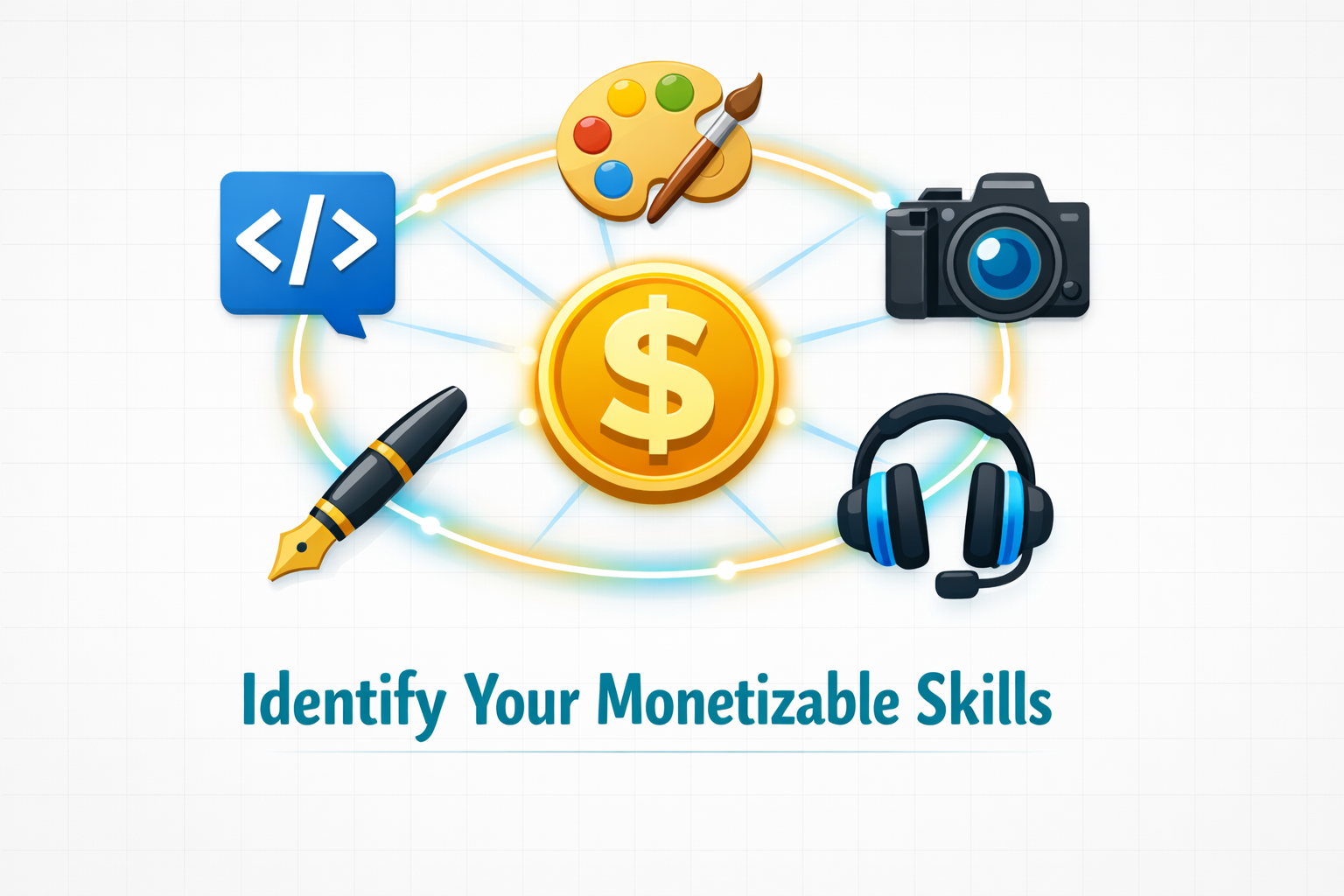
Step 1: Identify the Skills You Can Monetize
Before diving into platforms or strategies, the first step in figuring out how to turn skills into income online is taking honest stock of what skills are already in place.
What Counts as a Monetizable Skill?
Many people underestimate what they know. Here is a broad list of skills that businesses and individuals pay for online:
| Skill Category | Examples |
|---|---|
| Writing & Content | Copywriting, blogging, editing, SEO writing |
| Design & Visual | Graphic design, video editing, UI/UX, illustration |
| Tech & Development | Web development, app building, data analysis |
| Teaching & Coaching | Tutoring, online courses, life coaching |
| Marketing | Social media management, email marketing, ads |
| Admin & Operations | Virtual assistance, bookkeeping, project management |
| Creative Arts | Photography, music production, voiceover |
💡 Pull Quote: “You don’t need to be the world’s best at something. You just need to be good enough to solve someone else’s problem.”
How to Discover Hidden Skills
Not everyone knows what they are good at right away. Try these quick exercises:
- Ask friends or colleagues what they come to you for help with.
- Review past jobs or hobbies — what tasks came naturally?
- Take a free skills assessment on platforms like LinkedIn or Coursera.
- Look at what people pay for on Fiverr or Upwork in areas of personal interest.
Once a skill is identified, the next step is validating that people actually pay for it. A quick search on freelance platforms will show exactly what others are charging — and that is proof the market exists.
Step 2: Choose the Right Path to Earn Money Online
There is no single “best” way to monetize a skill. The right path depends on the skill type, available time, and income goals. Here are the three main routes:
Path 1: Freelancing 🖥️
Freelancing means offering services directly to clients on a project or ongoing basis. It is the fastest way to start earning because no upfront investment is needed.
Best platforms for freelancers:
- Upwork — Great for long-term client relationships; strong in tech, writing, and marketing.
- Fiverr — Ideal for packaged, productized services; good for beginners.
- Toptal — Premium platform for top-tier developers and designers.
- PeoplePerHour — Popular in Europe; good for creative and admin skills.
Realistic earnings for freelancers:
- Beginner: $15–$40/hour
- Intermediate: $40–$100/hour
- Expert: $100–$300+/hour
The key to landing the first client is a strong profile and at least 2–3 portfolio samples — even if they are mock projects created just to show ability.
Path 2: Digital Products 📦
Instead of trading time for money, digital products let skills generate income repeatedly from a single creation.
Popular digital product types:
- Online courses (Teachable, Udemy, Kajabi)
- eBooks and guides (Gumroad, Amazon KDP)
- Templates and tools (Etsy, Creative Market, Gumroad)
- Stock photos or music (Shutterstock, Pond5)
- Printables (Etsy)
📌 Example: A graphic designer creates a set of Canva resume templates and sells them on Etsy for $9 each. With 200 sales per month, that is $1,800 in mostly passive income.
This path takes more time upfront but can generate income while sleeping.
Path 3: Content Creation & Monetized Platforms 🎬
Content creation turns expertise into an audience — and then turns that audience into income.
Platforms and monetization methods:
- YouTube — Ad revenue, sponsorships, affiliate links
- TikTok / Instagram — Brand deals, creator funds
- Substack / Medium — Paid newsletters and subscriptions
- Podcast — Sponsorships, listener support (Patreon)
Content creation takes longer to build (typically 6–12 months before meaningful income), but it creates compounding, long-term revenue.

Step 3: Build a Simple Online Presence
One of the most overlooked steps in learning how to turn skills into income online is having a place to send potential clients or buyers. This does not need to be complicated.
The Minimum Viable Online Presence
At minimum, every online earner needs:
- A professional profile on at least one platform (LinkedIn, Upwork, Fiverr)
- A portfolio page — even a free Notion or Carrd page works
- A way to contact — a professional email address
For those going the content creation or digital product route, a simple website or landing page is worth setting up early. Tools like WordPress, Squarespace, or Carrd make this easy with no coding required.
Building a Portfolio From Scratch
No experience? No problem. Here is how to build a portfolio fast:
- Do 1–2 free or discounted projects for friends, nonprofits, or small businesses.
- Create spec work — design a fake brand, write a sample article, build a demo website.
- Document everything with before/after results, screenshots, and testimonials.
A portfolio with three strong examples is enough to land the first paying client.
Step 4: Price Skills Correctly and Avoid Undercharging
Underpricing is one of the most common mistakes beginners make. It signals low value and attracts difficult clients.
How to Set Rates
Use this simple formula to set a starting rate:
Hourly Rate = (Desired Monthly Income ÷ Billable Hours) × 1.3
The 1.3 multiplier accounts for taxes, unpaid admin time, and gaps between projects.
Quick pricing benchmarks for 2026:
| Service | Beginner Rate | Mid-Level Rate |
|---|---|---|
| Blog post (1,000 words) | $50–$100 | $150–$300 |
| Logo design | $100–$200 | $300–$600 |
| Social media management | $300/month | $800–$1,500/month |
| Web development (basic site) | $500–$1,000 | $2,000–$5,000 |
| Online course creation | $97–$197 | $297–$997 |
💡 Pro Tip: Research what competitors charge on Fiverr and Upwork before setting rates. Pricing in the middle of the market is a safe starting point.
Step 5: Land the First Client or Sale
Knowing how to turn skills into income online means nothing without action. Here is a practical checklist for landing the first client or making the first sale:
For Freelancers:
- ✅ Complete profile on Upwork or Fiverr (photo, bio, portfolio)
- ✅ Apply to 5–10 jobs per day with personalized proposals
- ✅ Reach out to 3–5 people in personal network who might need the service
- ✅ Offer a small introductory discount for the first client in exchange for a review
For Digital Products:
- ✅ Create the product (aim for “good enough,” not perfect)
- ✅ List it on Gumroad, Etsy, or Teachable
- ✅ Share it in 3–5 relevant online communities (Reddit, Facebook Groups, Discord)
- ✅ Collect feedback and improve
For Content Creators:
- ✅ Publish 10–20 pieces of content before expecting results
- ✅ Focus on one platform first
- ✅ Engage with others in the same niche to build community
- ✅ Add affiliate links or a digital product early to monetize from day one
Step 6: Scale Up Income Over Time
Once the first income is flowing, scaling becomes the focus. Here are proven ways to grow:
Raise Rates Regularly 📊
Every 3–6 months, review rates. As experience and reviews grow, rates should increase. A 20–30% rate increase after the first 10 clients is completely reasonable.
Add a Second Income Stream
The most resilient online earners combine multiple streams:
- Freelancing + a digital product
- Content creation + affiliate marketing
- Coaching + an online course
Specialize and Niche Down 🎯
Generalists compete with everyone. Specialists command premium rates.
Example: Instead of “freelance writer,” become a “SaaS email copywriter” or “health and wellness content writer.” Niche expertise attracts higher-paying clients and less competition.
Automate and Outsource
As income grows, reinvesting some of it into tools (scheduling software, email automation) or outsourcing lower-value tasks frees up time for higher-value work.
Realistic Income Expectations
Honesty matters here. Here is what most people can realistically expect:
| Timeline | Expected Monthly Income |
|---|---|
| Month 1–3 | $0–$500 (learning phase) |
| Month 3–6 | $500–$1,500 (first clients/sales) |
| Month 6–12 | $1,500–$4,000 (growing portfolio) |
| Year 1–2 | $4,000–$10,000+ (established presence) |
Results vary based on skill, effort, and niche. These are averages, not guarantees. But they are achievable for anyone who stays consistent.
Conclusion: Your Next Steps Start Today
Learning how to turn skills into income online is not about luck or secret formulas. It is about identifying what is already known, choosing the right platform, showing up consistently, and improving over time.
Here are the three immediate action steps to take right now:
- Write down 3 skills that could help someone else — even if they seem basic.
- Create a free profile on Fiverr, Upwork, or Gumroad today.
- Publish or pitch something within the next 7 days — a proposal, a product listing, or a piece of content.
The online economy in 2026 rewards people who start before they feel ready. The first step is always the hardest but it is also the most important. Skills have value. The internet is the marketplace. The only thing left to do is show up.