Quick Answer: The best ways to make money online for beginners in 2026 include freelancing, affiliate marketing, selling digital products, online tutoring, and completing microtasks. Most of these require little to no upfront investment, can be started within a week, and can realistically earn beginners anywhere from $200 to $2,000+ per month depending on the method, time invested, and skill level.
Key Takeaways
- Freelancing (writing, design, data entry) is the fastest way for most beginners to earn real income online, often within days of signing up on platforms like Upwork or Fiverr.
- Affiliate marketing has a longer ramp-up time (typically 3–6 months) but can generate passive income once content is established.
- Selling digital products (templates, e-books, printables) offers high profit margins because there’s no inventory or shipping.
- Online tutoring pays well ($15–$50/hour is common for subject tutors) and requires only verified knowledge, not a formal teaching degree, on many platforms.
- Microtask sites like Amazon Mechanical Turk or Prolific are genuinely beginner-friendly but pay modestly, making them best for supplemental income rather than a primary source.
- Realistic income expectations matter: most beginners earn $200–$500/month in the first 90 days. Scaling takes consistent effort.
- Scams are common in the online income space. Legitimate opportunities never require large upfront payments to “unlock” earnings.
- Choosing one method and sticking with it for at least 60–90 days beats jumping between strategies.
What Are the Best Ways to Make Money Online for Beginners?
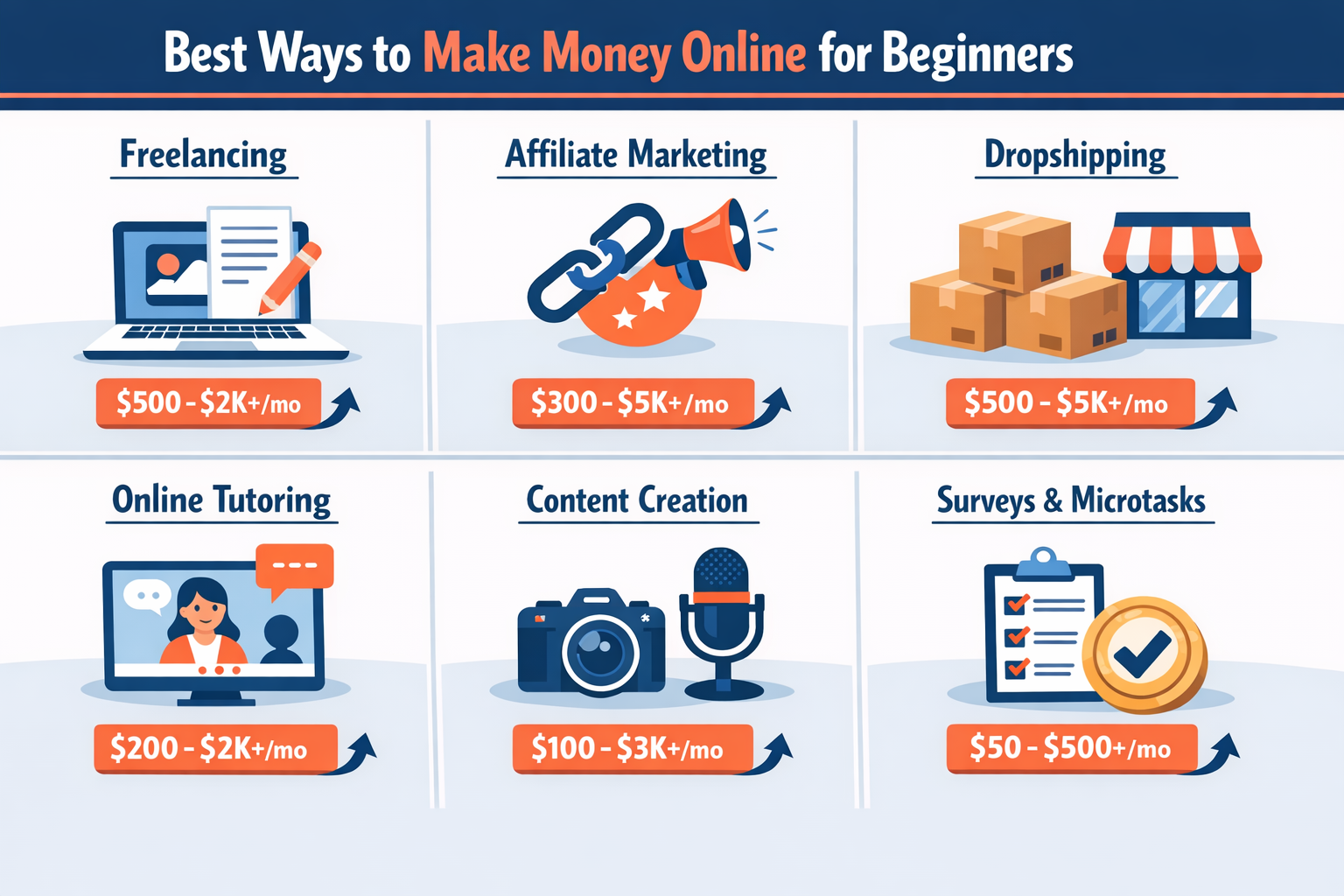
The best ways to make money online for beginners are methods that have a low barrier to entry, don’t require specialized degrees, and can generate income within weeks rather than years. Six methods consistently stand out for beginners in 2026.
1. 💻 Freelancing
Freelancing means selling a specific skill to clients on a per-project or hourly basis. It’s the most direct path from zero to paid work online.
Skills that sell well for beginners:
- Copywriting and blog writing
- Graphic design (Canva-based work counts)
- Virtual assistant tasks (email management, scheduling)
- Data entry and spreadsheet work
- Social media content creation
Where to start: Upwork, Fiverr, and Freelancer.com are the most beginner-accessible platforms. Create a profile, list one clear service, and apply to 5–10 jobs per day for the first two weeks.
Realistic income: $300–$1,500/month in the first 3 months, scaling to $3,000–$5,000+ as reviews and reputation build.
Common mistake: Pricing too low to “get clients faster.” Extremely low rates attract difficult clients and signal low quality. Start at a fair market rate, not rock-bottom.
2. 📢 Affiliate Marketing
Affiliate marketing means promoting other companies’ products and earning a commission when someone buys through your unique link. It’s one of the best ways to make money online for beginners who enjoy creating content.
How it works (simplified):
- Join an affiliate program (Amazon Associates, ShareASale, or individual brand programs).
- Create content — a blog post, YouTube video, or social media post — that includes your affiliate link.
- When a reader clicks and buys, you earn a percentage of the sale (typically 3–20% depending on the program).
Realistic timeline: 3–6 months before meaningful income. Affiliate marketing rewards patience and consistent content creation.
Choose this if: You enjoy writing, making videos, or building an audience around a topic you already know well (fitness, cooking, personal finance, tech gadgets, etc.).
Avoid this if: You want income within the next 30 days. Freelancing or tutoring will get you there faster.
3. 🛍️ Selling Digital Products
Digital products — e-books, Notion templates, Canva graphics, online courses, stock photos — are created once and sold repeatedly with no shipping or inventory costs.
Popular platforms: Etsy (for printables and templates), Gumroad, Teachable, and Payhip.
Profit margins are high because the main cost is your time to create the product. A $15 Notion template on Etsy costs nothing to reproduce after the first sale.
Realistic income: Highly variable. Some sellers earn $50/month; others scale to $5,000+/month. Success depends on niche selection and marketing effort.
Quick example: A beginner creates five resume templates in Canva, lists them on Etsy for $9 each, and sells 30 copies in the first month — earning $270 with no ongoing work beyond occasional shop updates.
4. 🎓 Online Tutoring and Teaching
Online tutoring pays beginners well relative to the time invested. Platforms like Preply, Wyzant, and Cambly connect tutors with students worldwide.
What you need:
- Solid knowledge of a subject (math, English, science, a second language, music, coding)
- A quiet space and a reliable internet connection
- A basic webcam
Typical pay rates:
| Platform | Hourly Rate Range | Subject Focus |
|---|---|---|
| Preply | $15–$40/hr | Languages, academics |
| Wyzant | $25–$80/hr | K-12, test prep |
| Cambly | $10.20/hr (fixed) | English conversation |
| Outschool | Variable | Kids’ enrichment classes |
No teaching degree required on most platforms, though subject expertise and good reviews matter for attracting students.
5. 📋 Microtasks and Paid Surveys
Microtask platforms pay users to complete small, simple tasks: categorizing images, transcribing short audio clips, testing apps, or answering survey questions.
Legitimate platforms:
- Amazon Mechanical Turk (MTurk)
- Prolific (research surveys, pays better than most)
- UserTesting (website usability tests, pays $10–$60 per test)
- Swagbucks (surveys and simple tasks)
Honest income expectation: $50–$200/month for part-time effort. This is supplemental income, not a replacement for a job. UserTesting pays the best per hour among this category.
Best for: Complete beginners who want to earn something immediately while building skills for higher-paying methods.
6. 🛒 Dropshipping and Print-on-Demand
Dropshipping means selling products online without holding inventory. When a customer orders, a third-party supplier ships the product directly to them. Print-on-demand works similarly but for custom-designed products (t-shirts, mugs, phone cases).
Platforms: Shopify + DSers for dropshipping; Printful or Printify integrated with Etsy for print-on-demand.
Startup costs: Shopify costs $39/month (as of 2026). Etsy charges listing fees of $0.20 per item. Print-on-demand has no upfront product cost.
Realistic income: Beginners often break even in months 1–3 while learning. Profit typically comes in months 4–6 as marketing improves.
Common mistake: Picking a product without researching demand. Use tools like Google Trends or Etsy search to validate that people are actively looking for what you plan to sell.
How Much Can Beginners Realistically Earn Online?
Beginners can realistically earn $200–$800/month within the first 90 days using methods like freelancing, tutoring, or microtasks. Higher-ceiling methods like affiliate marketing or selling digital products typically take 3–6 months to generate meaningful income.
Here’s a realistic breakdown by method and time horizon:
| Method | Month 1–2 Estimate | Month 4–6 Estimate | Income Ceiling |
|---|---|---|---|
| Freelancing | $200–$600 | $800–$2,500 | $5,000+/month |
| Affiliate Marketing | $0–$50 | $100–$500 | Unlimited (passive) |
| Digital Products | $0–$100 | $200–$1,000 | $5,000+/month |
| Online Tutoring | $150–$500 | $500–$2,000 | $3,000+/month |
| Microtasks/Surveys | $50–$150 | $100–$200 | ~$300/month |
| Dropshipping/POD | -$50 to $100 | $200–$800 | $10,000+/month |
These are estimates based on typical beginner trajectories and publicly reported platform data. Individual results vary significantly based on time invested, niche, and consistency.
What Skills Do Beginners Need to Make Money Online?
Most online income methods for beginners require only basic digital literacy and a willingness to learn. No coding degree or MBA is necessary.
Skills that help across almost every method:
- Basic written communication (clear emails, descriptions, proposals)
- Comfort using platforms like Google Docs, Canva, or Zoom
- Self-discipline to work without a manager
- Patience during the ramp-up period
Skills worth learning quickly (free resources available):
- SEO basics (for affiliate marketing and blogging) — Google’s Search Essentials documentation is free
- Canva design (for digital products and social content) — Canva’s free tutorials cover the essentials in under 2 hours
- Copywriting fundamentals (for freelancing) — free resources on Copyblogger and HubSpot’s blog
The honest truth: Skill-building is ongoing. The beginners who earn the most aren’t the most talented — they’re the most consistent.
How Do Beginners Avoid Online Money-Making Scams?
Scams targeting people searching for online income are widespread. Beginners can avoid them by knowing the red flags.
🚩 Red flags to watch for:
- Any opportunity that requires you to pay money upfront to “start earning”
- Promises of specific income amounts (“Earn $500/day guaranteed!”)
- Vague descriptions of what the actual work involves
- Pressure to recruit others to earn (MLM structure)
- Requests for your bank account details before you’ve done any work
Legitimate platforms (Upwork, Fiverr, Etsy, Preply, Prolific) never charge you to apply or accept work. They take a percentage of earnings after you’ve been paid.
Rule of thumb: If an opportunity sounds too easy and too lucrative for the effort described, it almost certainly is.
What Is the Fastest Way for a Beginner to Make Money Online?
The fastest legitimate path for most beginners is freelancing or online tutoring, both of which can generate a first payment within 7–14 days of starting.
Step-by-step for a fast start with freelancing:
- Identify one skill you already have (writing, design, data entry, social media, etc.).
- Create a free profile on Fiverr or Upwork (takes 30–60 minutes).
- Write a clear, specific service description. Example: “I will write 500-word blog posts on health and wellness topics.”
- Set a competitive but fair starting rate.
- Apply to 5–10 relevant job listings per day, or activate your Fiverr gig.
- Deliver excellent work on your first job and ask for a review.
Most beginners who follow this consistently land their first client within 1–2 weeks.
How Do Beginners Choose the Right Online Income Method?
The right method depends on three factors: available time, existing skills, and income urgency. Beginners who need money within 30 days should prioritize freelancing or tutoring. Those with 3–6 months of runway can invest time in affiliate marketing or digital products for longer-term returns.
Decision guide:
- Need income in under 30 days? → Freelancing or online tutoring
- Have a hobby or niche you’re passionate about? → Affiliate marketing or digital products
- Want zero startup cost? → Microtasks, Prolific surveys, or Fiverr (free to join)
- Comfortable with some financial risk? → Dropshipping or print-on-demand
- Have strong subject knowledge? → Online tutoring on Preply or Wyzant
Pick one method. Commit to it for 60–90 days before evaluating results or switching. The biggest mistake beginners make is trying three methods at once and doing none of them well.
FAQ: Making Money Online for Beginners
Q: Can I make money online with no experience at all?
Yes. Platforms like Fiverr, Prolific, and Etsy are designed for people without formal credentials. Microtasks and basic freelance services (data entry, proofreading) require no prior professional experience.
Q: How many hours per week do I need to invest?
Even 10–15 hours per week is enough to start earning with freelancing or tutoring. Affiliate marketing and digital products benefit from more consistent effort early on, but can become more passive over time.
Q: Do I need a website to make money online?
No. Freelancing platforms, Etsy, and tutoring sites handle everything. A website becomes useful later for affiliate marketing or selling digital products directly, but it’s not required to start.
Q: Is affiliate marketing still worth it in 2026?
Yes, but it’s more competitive than it was five years ago. Success requires focusing on a specific niche, creating genuinely helpful content, and building an audience consistently over several months.
Q: What are the tax implications of earning money online?
In most countries, online income is taxable regardless of the source or platform. In the United States, freelancers and self-employed individuals typically need to report income and may owe self-employment tax. Consult a tax professional or use IRS.gov resources for guidance specific to your situation.
Q: Can I do this from any country?
Most platforms accept international users, though payment options vary. PayPal, Payoneer, and Wise are commonly used for cross-border payments. Check each platform’s country availability before signing up.
Q: How do I get my first client on Upwork with no reviews?
Write highly specific proposals tailored to each job posting (not copy-paste templates), offer a competitive rate, and showcase any relevant samples — even personal projects count. A well-written proposal beats a long job history for many clients.
Q: Are paid survey sites worth the time?
For most people, no — not as a primary income source. Sites like Prolific pay better than average ($6–$12/hour equivalent) and are worth using during downtime, but they won’t replace meaningful income from freelancing or tutoring.
Q: What’s the biggest mistake beginners make?
Switching methods too quickly. Most beginners abandon a strategy after 2–3 weeks because results are slow, then repeat the cycle. Consistent effort over 60–90 days is what separates those who earn from those who don’t.
Q: Do I need a PayPal account?
PayPal is accepted on many platforms but isn’t universal. Stripe, Payoneer, and direct bank transfers are alternatives. Check your preferred platform’s payment options before starting.
Conclusion: Your Next Steps Start Today
The best ways to make money online for beginners in 2026 are accessible, real, and proven — but they require consistent action, not just research. Here’s a simple plan to move forward:
- Choose one method from this guide that matches your skills and timeline.
- Set up your profile or account on the relevant platform today (not tomorrow).
- Commit to 60–90 days of consistent effort before evaluating whether it’s working.
- Track your income and time in a simple spreadsheet so you can see real progress.
- Reinvest early earnings into tools or education that help you scale (a better microphone for tutoring, a Canva Pro subscription for design work, etc.).
Starting is the hardest part. Every experienced online earner was once exactly where you are now. Pick a method, take the first step, and build from there.