Quick Answer: The top freelancing jobs for beginners with no experience include data entry, transcription, virtual assistance, social media management, content writing, and basic graphic design. These roles require minimal upfront skills, can be started on platforms like Fiverr or Upwork within days, and can realistically earn beginners $300 to $1,500 per month as they build their portfolio.
Key Takeaways
- The top freelancing jobs for beginners with no experience are accessible, low-barrier, and can be started from home with just a laptop and internet connection.
- Data entry, transcription, and virtual assistance are the easiest entry points because they rely on skills most people already have.
- Platforms like Fiverr, Upwork, and Freelancer.com let beginners create profiles for free and start applying for work immediately.
- Beginners should expect to earn less at first while building reviews and a portfolio, then raise rates as experience grows.
- Picking one niche and mastering it is more effective than spreading across many services at once.
- Free tools like Canva (design), Grammarly (writing), and Otter.ai (transcription) lower the barrier to entry even further.
- Realistic income for a part-time beginner freelancer ranges from $300 to $1,500 per month in the first 90 days, depending on hours and niche.
- Scams are common in the freelancing space; always use platform payment systems and never pay upfront fees to get work.
What Is Freelancing and Is It Right for Beginners?
Freelancing means working for clients on a project or contract basis instead of being a full-time employee. Beginners can absolutely start freelancing with no prior professional experience, as long as they have basic computer skills and a willingness to learn.
Freelancing works well for students, stay-at-home parents, recent graduates, and anyone looking to earn extra income from home. It doesn’t require a degree, a resume full of credentials, or startup capital. What it does require is consistency, communication, and a realistic mindset about early earnings.
Choose freelancing if:
- You want flexible hours and the ability to work from home.
- You’re willing to start at lower rates and build up over time.
- You can handle some income variability month to month.
Freelancing may not suit you if:
- You need a guaranteed paycheck from day one.
- You struggle with self-motivation or managing your own schedule.
What Are the Top Freelancing Jobs for Beginners With No Experience?
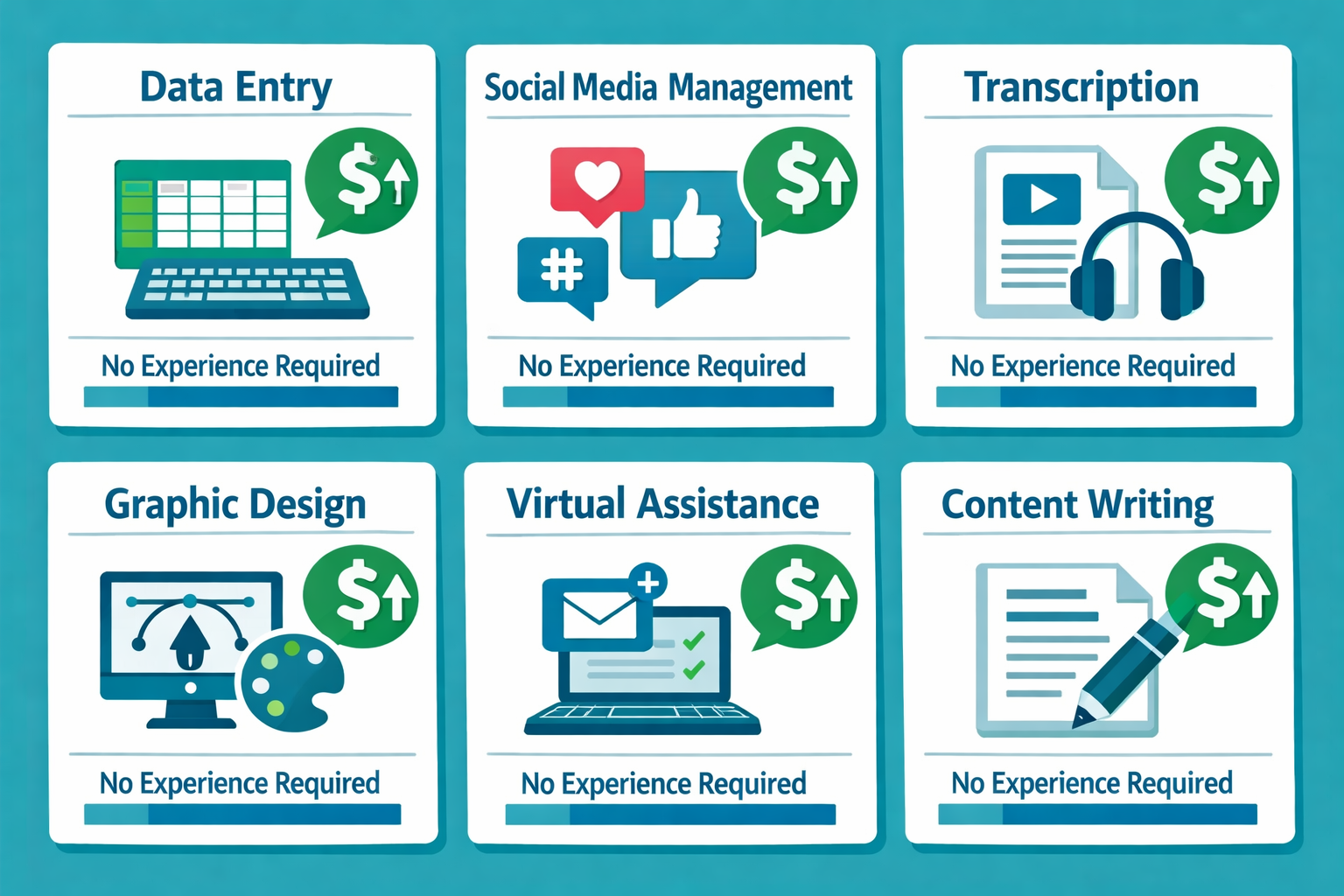
The best beginner freelancing jobs are those that require skills most people already have, have steady client demand, and don’t need expensive tools or formal training to get started.
Here are the top options, ranked roughly from easiest to start to slightly more skill-dependent:
1. Data Entry
What it is: Copying, organizing, or inputting information into spreadsheets, databases, or online systems.
Why it’s beginner-friendly: Almost anyone who can type and use Microsoft Excel or Google Sheets qualifies. No specialized knowledge is needed.
Realistic pay: $10 to $20 per hour for beginners, according to estimates from platforms like Upwork (2024 rate data).
Where to find work: Upwork, Fiverr, Clickworker, Amazon Mechanical Turk.
Common mistake: Accepting very low-paying bulk tasks that don’t scale. Focus on clients who need ongoing data management, not one-time micro-tasks.
2. Transcription
What it is: Listening to audio or video recordings and typing out what is said, word for word.
Why it’s beginner-friendly: Good listening skills and accurate typing are all that’s needed to start. Many clients don’t require prior transcription experience.
Realistic pay: $15 to $25 per audio hour for general transcription; medical or legal transcription pays more but requires training.
Where to find work: Rev.com, TranscribeMe, GoTranscript, Upwork.
Tip: Use free tools like oTranscribe or Otter.ai to work faster and increase earnings per hour.
3. Virtual Assistant (VA)
What it is: Providing administrative support to businesses or entrepreneurs remotely, including scheduling, email management, research, and data organization.
Why it’s beginner-friendly: Most VA tasks mirror everyday computer skills. Clients often train VAs on their specific systems.
Realistic pay: $12 to $25 per hour for general VAs; specialized VAs (social media, bookkeeping) earn more.
Where to find work: Upwork, Belay, Time Etc, Zirtual, LinkedIn.
Edge case: Some VA roles require familiarity with tools like Asana, Trello, or HubSpot. Free tutorials on YouTube can cover these basics in a few hours.
4. Social Media Management
What it is: Creating, scheduling, and managing posts for a business’s social media accounts (Instagram, Facebook, LinkedIn, TikTok).
Why it’s beginner-friendly: If someone uses social media regularly, they already understand the basics. Small businesses often need help and can’t afford agencies.
Realistic pay: $200 to $600 per month per client for basic management (3 to 5 posts per week).
Where to find work: Fiverr, Upwork, local business outreach, Facebook groups.
Decision rule: Choose social media management if you enjoy creating content and are comfortable with tools like Canva or Buffer. Avoid it if you dislike writing or visual design.
5. Content Writing and Blog Writing
What it is: Writing articles, blog posts, product descriptions, or website copy for clients.
Why it’s beginner-friendly: Strong writing skills and basic research ability are enough to start. Many clients provide outlines or briefs.
Realistic pay: $15 to $50 per article for beginners; rates rise sharply with a portfolio and niche expertise.
Where to find work: Fiverr, Upwork, ProBlogger Job Board, Contena, LinkedIn.
Common mistake: Writing for content mills at $1 to $3 per article. These don’t build a portfolio or sustainable income. Aim for direct clients or mid-tier platforms instead.
6. Basic Graphic Design
What it is: Creating social media graphics, logos, flyers, or presentations using tools like Canva or Adobe Express.
Why it’s beginner-friendly: Canva’s free plan makes it possible to create professional-looking designs with no formal training. Many clients specifically request Canva-based work.
Realistic pay: $5 to $50 per design depending on complexity; logo design can earn $50 to $150 for beginners.
Where to find work: Fiverr, 99designs (for contests), Upwork, Etsy (for digital templates).
Tip: Sell pre-made Canva templates on Etsy as a passive income stream alongside client work.
How Do Beginners Find Their First Freelancing Client?
Getting the first client is the hardest part. The key is to lower the barrier for potential clients by offering competitive rates, clear deliverables, and fast turnaround.
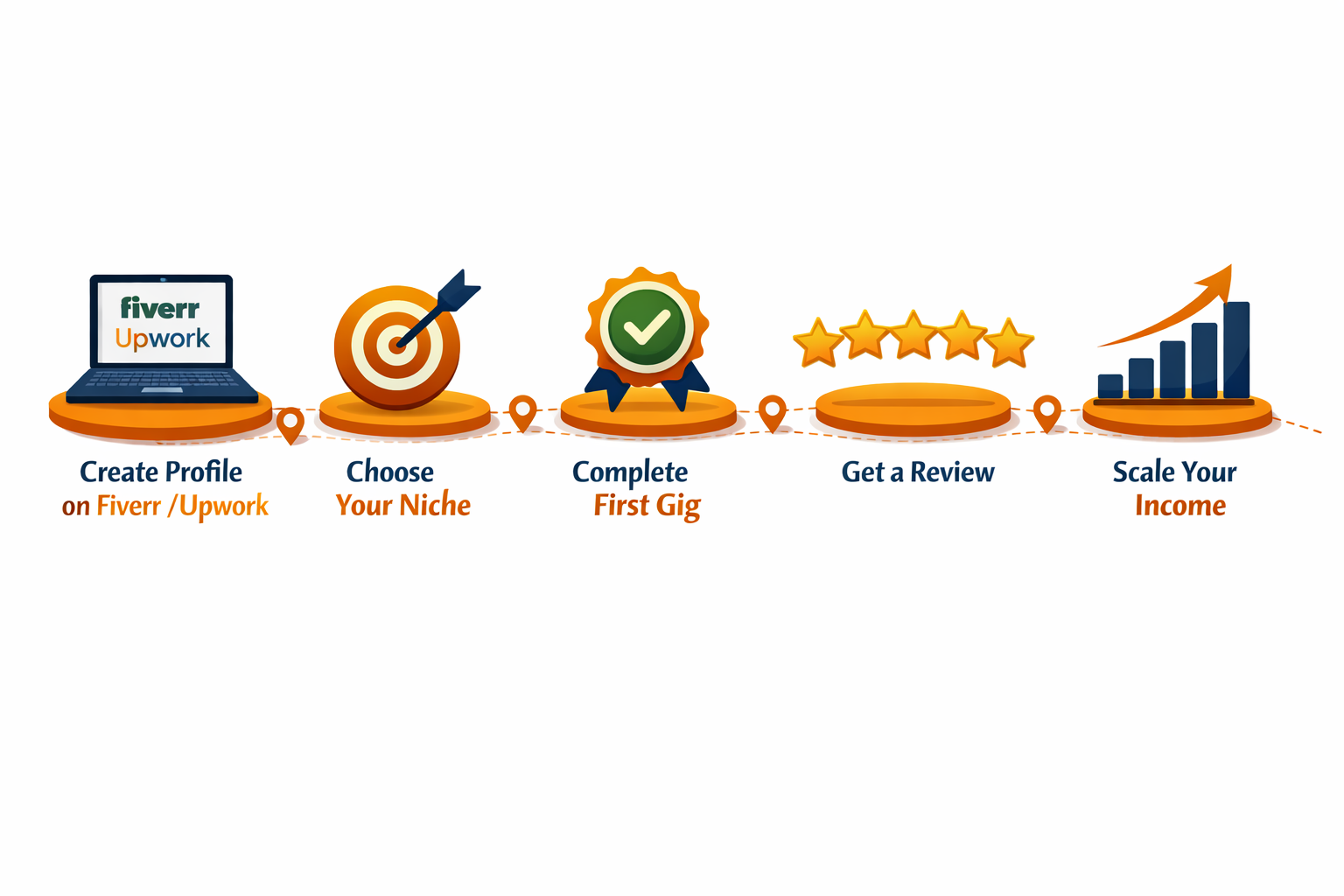
Step-by-step approach for beginners:
- Pick one service from the list above. Don’t offer everything at once.
- Create a profile on Fiverr or Upwork. Fill it out completely with a clear description of what you offer.
- Write a sample or portfolio piece even if it’s self-created. A sample blog post, a mock social media graphic, or a transcription sample shows clients what to expect.
- Apply to 5 to 10 jobs per day in the early weeks. Personalize each proposal to the client’s specific needs.
- Price competitively at first. Charging slightly below market rate for the first 3 to 5 jobs helps win reviews faster.
- Ask for a review after every completed job. Reviews are the primary currency of freelancing platforms.
💡 Pro tip: Reaching out to local small businesses directly (restaurants, salons, real estate agents) via email or social media can be faster than competing on crowded platforms.
What Platforms Should Beginners Use in 2026?
The right platform depends on the service being offered and how much competition a beginner is comfortable facing.
| Platform | Best For | Fee Structure | Beginner-Friendly? |
|---|---|---|---|
| Fiverr | Design, writing, transcription | 20% commission | ✅ Yes |
| Upwork | VA, writing, data entry | 20% (drops with earnings) | ✅ Yes |
| Freelancer.com | Mixed services | 10% or $5 per project | ✅ Yes |
| Rev.com | Transcription only | Per-audio-minute pay | ✅ Yes |
| Toptal | Tech, finance, design | Invite-only | ❌ Not for beginners |
| VA, writing, social media | Free to apply | ✅ Yes (with effort) |
Choose Fiverr if you want clients to come to you (inbound model). Choose Upwork if you prefer applying to posted jobs (outbound model). Both work well for beginners.
How Much Can Beginners Realistically Earn Freelancing?
Beginners should expect modest income in the first 30 to 60 days while building their reputation, then steady growth after that.
Realistic income estimates for part-time beginners (10 to 20 hours per week):
- Month 1: $100 to $400 (building profile, winning first clients)
- Month 2 to 3: $400 to $1,000 (repeat clients, growing reviews)
- Month 4 to 6: $1,000 to $2,500 (niche established, rates increasing)
These are estimates based on common freelancer reports on platforms like Reddit’s r/freelance and Upwork community forums, not guaranteed outcomes. Results vary based on niche, hours invested, and platform chosen.
The biggest income lever is specialization. A general content writer earns less than a writer who specializes in SaaS product descriptions or personal finance blogs.
What Mistakes Do Beginner Freelancers Make Most Often?
Knowing what to avoid is just as valuable as knowing what to do. These are the most common pitfalls:
- Underpricing permanently. Starting low is fine; staying low is a trap. Raise rates after the first 5 to 10 positive reviews.
- Offering too many services. Clients trust specialists more than generalists. Pick one or two services and go deep.
- Skipping the contract. Even a simple written agreement protects both parties. Upwork and Fiverr have built-in contracts, but direct clients need a written scope of work.
- Ignoring communication. Slow responses lose clients. Aim to reply within a few hours during business hours.
- Falling for scams. Legitimate clients never ask freelancers to pay upfront fees, buy gift cards, or move off-platform to avoid fees. Always use platform payment systems.
FAQ: Top Freelancing Jobs for Beginners With No Experience
Q: Can someone really start freelancing with zero experience?
Yes. Many beginner-friendly freelancing jobs like data entry, transcription, and basic social media management require only computer literacy and attention to detail, not prior professional experience.
Q: How long does it take to get the first freelancing client?
On platforms like Fiverr or Upwork, most beginners land their first client within 1 to 4 weeks if they apply consistently and price competitively.
Q: Is freelancing taxable income?
Yes. Freelance income is self-employment income and must be reported to tax authorities. In the U.S., freelancers who earn more than $400 per year from self-employment must file a Schedule SE. Consult a local tax professional for country-specific rules.
Q: Do beginners need a PayPal account to get paid?
Most platforms offer multiple payout options including PayPal, bank transfer, and Payoneer. PayPal is common but not always required. Check the specific platform’s payment options before signing up.
Q: What’s the easiest freelancing job to start today?
Data entry and transcription are generally the fastest to start because they require no portfolio, no design skills, and no specialized knowledge beyond basic typing accuracy.
Q: How many hours per week does freelancing require?
Beginners can start with as few as 5 to 10 hours per week. Most part-time freelancers work 10 to 20 hours weekly while keeping a day job.
Q: Is Fiverr or Upwork better for beginners?
Fiverr is often easier for absolute beginners because clients find you through your gig listing. Upwork requires writing proposals, which takes more effort but can lead to higher-paying clients.
Q: Do beginners need a website to start freelancing?
No. A platform profile on Fiverr or Upwork is enough to start. A personal website becomes useful later for attracting direct clients and building credibility.
Q: What free tools help beginner freelancers?
Canva (design), Grammarly (writing), Google Docs (documents), Trello (task management), and Otter.ai (transcription) are all free and widely used by beginner freelancers.
Q: Can freelancing become a full-time income?
Yes, but it typically takes 6 to 18 months of consistent effort to replace a full-time salary. Most freelancers start part-time and transition gradually.
Conclusion: How to Start Freelancing This Week
The top freelancing jobs for beginners with no experience are not a secret, and they’re not out of reach. Data entry, transcription, virtual assistance, social media management, content writing, and basic graphic design all offer real income potential without requiring a degree, a portfolio, or years of experience.
Here’s what to do next, step by step:
- Choose one service from this list that matches skills already possessed or that can be learned quickly with free resources.
- Sign up on Fiverr or Upwork today and complete the profile fully.
- Create one sample piece to show potential clients what to expect.
- Apply to or create listings for 5 jobs this week. Don’t wait for the perfect moment.
- Deliver excellent work on the first few jobs, ask for reviews, and raise rates after building credibility.
The income won’t be life-changing in week one. But with consistent effort over 60 to 90 days, freelancing can become a meaningful side income or the foundation of a full-time career. The only requirement is starting.