
Nigeria’s remittances surged 97.4% year-on-year to $107.47 million in January 2026 alone — yet thousands of Nigerian freelancers and digital sellers still struggle to collect a single dollar from foreign clients without hitting a wall of failed transfers, blocked accounts, or confusing fees. If you’ve ever landed a client abroad and then panicked about how to actually collect your money, you’re not alone.
Knowing how to receive international payments in Nigeria safely and efficiently is one of the most critical skills for anyone building an online income in 2026. The wrong platform can cost you money, delay your cash, or even get your account flagged. The right one? It can mean the difference between a thriving freelance career and a frustrating dead end.
In this guide, I’ll break down exactly how Payoneer, Wise, and Paystack work — in plain English — so you can choose the best tool for your situation and start getting paid today.
Key Takeaways
- Payoneer is currently the top choice for Nigerian freelancers on platforms like Upwork and Fiverr, thanks to strong local bank integrations.
- Wise offers excellent mid-market exchange rates but has suspended NGN withdrawals in Nigeria due to regulatory changes — making it less practical for most Nigerians right now.
- Paystack is best for Nigerian entrepreneurs selling digital products to customers who pay by card, not for receiving freelance payments from abroad.
- New CBN rules in 2026 are reshaping how platforms operate in Nigeria — staying informed protects your income.
- There are strong emerging alternatives like Grey and Hurupay worth considering alongside the big three.
Why Receiving International Payments Is Difficult in Nigeria
Let me tell you about Chidi. He’s a graphic designer from Enugu who landed his first international client on Fiverr. The client was ready to pay $200. Chidi was ecstatic — until he realized he had no idea how to receive the money. He tried PayPal (not fully supported in Nigeria for withdrawals), then tried a friend’s account (risky), and nearly lost the client from the delay.
This story plays out every day across Nigeria.
Here’s why it’s genuinely difficult:
- 🏦 Banking restrictions: Nigerian banks have strict foreign exchange controls that limit how USD flows into personal accounts.
- 📋 Regulatory complexity: The Central Bank of Nigeria (CBN) introduced new rules in March 2026 requiring all International Money Transfer Operators (IMTOs) to maintain naira settlement accounts with authorized banks — tightening how foreign remittances flow in [8].
- 💳 Limited PayPal access: PayPal allows Nigerians to send money but severely restricts receiving and withdrawing funds.
- 🌍 Platform restrictions: Many global payment tools simply don’t support Nigeria fully.
- 📉 Currency volatility: The naira’s instability means the timing of your withdrawal can significantly affect how much you actually receive.
Despite these challenges, there are solid, legal, and reliable ways to receive international payments in Nigeria — and I’m going to show you exactly how.
Overview of Payment Options Available
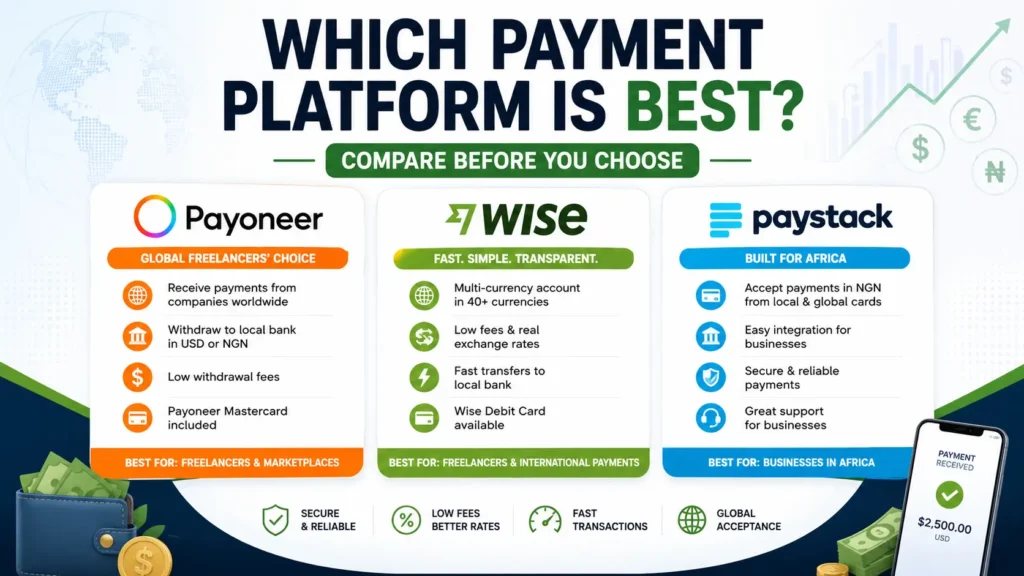
Before diving deep, here’s a quick map of the landscape:
| Platform | Best For | USD Receipt | NGN Withdrawal |
|---|---|---|---|
| Payoneer | Freelancers (Upwork, Fiverr) | ✅ Yes | ✅ Yes (with delays) |
| Wise | International transfers | ✅ Yes | ⚠️ Suspended (2026) |
| Paystack | Digital product sellers | ✅ Limited | ✅ Yes (domiciliary) |
| Grey | Direct client payments | ✅ Yes | ✅ Yes |
| Hurupay | Fast USD settlements | ✅ Yes | ✅ Yes |
We’ll focus primarily on Payoneer, Wise, and Paystack — but I’ll also flag where Grey and Hurupay fill important gaps [5][9].
Payoneer Explained: How to Receive International Payments in Nigeria
How Payoneer Works
Payoneer gives you a US bank account number (and EU/UK equivalents) that you can share with clients or marketplaces. When someone pays you, the money lands in your Payoneer balance. You can then withdraw it to your Nigerian bank account in naira or keep it in USD.
It’s the most widely used platform for Nigerian freelancers — and for good reason. Payoneer has direct integrations with Upwork, Fiverr, Toptal, and dozens of other freelance marketplaces [2].
Setting Up Payoneer (Basic Steps)
- Go to Payoneer.com and click “Sign Up”
- Choose “I want to get paid by companies or marketplaces”
- Fill in your personal details (name, date of birth, address)
- Provide your Nigerian bank account details
- Upload a valid ID (NIN slip, international passport, or driver’s license)
- Wait for approval (usually 1–3 business days)
- Once approved, access your US Payment Service account details to share with clients [10]
Payoneer Pros ✅
- Marketplace integrations: Works seamlessly with Upwork, Fiverr, Amazon, and more
- Local bank support: Withdraws to GTBank, Access, Zenith, and other major Nigerian banks
- Multi-currency support: Hold USD, EUR, GBP, and more
- Established and trusted: Over 5 million users globally
- Payoneer card: Spend your balance directly
Payoneer Cons ❌
- New maintenance fee: From February 23, 2026, accounts receiving less than $6,000 annually are charged a $30 annual maintenance fee — a significant hit for low-volume freelancers [1]
- Withdrawal delays: Post-CBN regulation changes in 2026, some Nigerian users have reported delays when withdrawing to local banks [1]
- Currency conversion markup: Payoneer charges 2–3% on currency conversions, which adds up
- Customer support: Can be slow and frustrating for Nigerians facing account issues
💡 Pull Quote: “Payoneer is still the king for marketplace freelancers in Nigeria — but the new $30 fee means you need to be earning consistently to justify it.”
Who Should Use Payoneer?
Payoneer is ideal if you work on Upwork, Fiverr, or Toptal, or if you have international clients who pay via bank transfer. It’s the most battle-tested option for Nigerian freelancers receiving USD online [9].
Wise Explained: Mid-Market Rates With a Nigerian Catch
How Wise Works
Wise (formerly TransferWise) is celebrated globally for using the real mid-market exchange rate — the fairest rate available — with transparent, low fees. You get virtual bank account details in multiple currencies and can receive payments from clients worldwide.
How Wise Works in Practice
A client in the US sends $500 to your Wise USD account. Wise holds it, and you can convert it to naira or another currency. Sounds perfect, right?
Here’s the problem in 2026: Wise has suspended NGN withdrawals in Nigeria due to the tightening regulatory environment following the CBN’s new IMTO rules. This makes Wise significantly less useful for Nigerians who need to convert their USD to naira [9].
Setting Up Wise (Basic Steps)
- Visit Wise.com and create a personal account
- Verify your identity with a government-issued ID
- Navigate to “Account Details” to get your USD virtual account number
- Share these details with your international clients
- Note: Currently, direct NGN withdrawal to Nigerian banks is restricted
Wise Pros ✅
- Best exchange rates: Uses the real mid-market rate — no hidden markup
- Transparent fees: You see exactly what you pay before confirming
- Multi-currency wallet: Hold 40+ currencies
- Fast international transfers: Often same-day or next-day
- Trusted globally: Regulated in multiple jurisdictions
Wise Cons ❌
- NGN withdrawal suspended: You currently cannot withdraw directly to Nigerian naira bank accounts [9]
- Limited Nigeria functionality: Many features available in Europe/US are restricted for Nigerians
- Not integrated with freelance marketplaces: Upwork and Fiverr don’t pay directly to Wise
- Workarounds needed: Some Nigerians use Wise to receive USD, then transfer to Grey or another platform — adding complexity
Who Should Use Wise?
Wise is best for Nigerians who have a foreign bank account or domiciliary account and want to move money between currencies at the best rates. For most beginners trying to receive USD in Nigeria right now, Wise is not the most practical starting point [9].
Paystack Explained: Great for Selling, Not for Freelancing
How Paystack Works
Paystack is a Nigerian-founded payment gateway (acquired by Stripe in 2020) that allows businesses to accept card payments online. It’s primarily designed for entrepreneurs selling products or services to customers — think online stores, course creators, and SaaS businesses.
Paystack is not a tool for receiving freelance payments from a foreign employer. It’s a tool for charging your own customers.
How Paystack Works in Practice
You build a simple checkout page or integrate Paystack into your website. A customer in the US enters their card details and pays $50 for your digital product. Paystack processes the payment and settles it to your domiciliary account (for USD) or naira account [7].
Setting Up Paystack (Basic Steps)
- Go to Paystack.com and register a business account
- Provide your business name, type, and Nigerian bank details
- Complete KYC verification (BVN, ID, business documents)
- Integrate Paystack into your website or use a payment link
- For USD settlements, link a Zenith Bank USD domiciliary account [7]
- Set your pricing in USD and start accepting international card payments
Paystack Pros ✅
- Easy integration: Works with WordPress, Shopify, and custom websites
- Accepts international cards: Visa and Mastercard from any country
- Payment links: No website needed — share a link directly
- Trusted in Nigeria: Widely used and well-regulated
- Good for digital products: Courses, eBooks, templates, subscriptions
Paystack Cons ❌
- High fees for USD: 3.9% per transaction for international card payments [7]
- Not for freelancers: You can’t use Paystack to receive payment from Upwork or a direct client employer
- Domiciliary account required: USD payouts require a USD domiciliary account (Zenith Bank recommended) — an extra step for beginners
- Chargeback risk: International card payments carry chargeback risks for sellers
Who Should Use Paystack?
Paystack is perfect for digital product sellers, course creators, and online business owners who want to charge international customers by card. It’s not suitable for freelancers waiting to be paid by a client or marketplace [7].
Payoneer vs Wise vs Paystack: Full Comparison Table
| Feature | Payoneer | Wise | Paystack |
|---|---|---|---|
| Best For | Freelancers | International transfers | Digital sellers |
| USD Receipt | ✅ Yes | ✅ Yes | ✅ Yes (card payments) |
| NGN Withdrawal | ✅ Yes (some delays) | ❌ Suspended | ✅ Yes (domiciliary) |
| Marketplace Integration | ✅ Upwork, Fiverr | ❌ No | ❌ No |
| Exchange Rate | 2–3% markup | Mid-market (best) | Varies |
| Annual Fee | $30 (if <$6K/year) | None | None |
| Transaction Fee | ~2% | 0.5–1.5% | 3.9% (international) |
| Setup Difficulty | Easy | Moderate | Moderate |
| Beginner Friendly | ✅ Yes | ⚠️ Limited | ✅ Yes (for sellers) |
| 2026 Nigeria Status | Active (with caveats) | Limited | Active |
Best Option for Freelancers vs Digital Sellers

🧑💻 If You’re a Freelancer
Go with Payoneer as your primary tool. Despite the new $30 annual fee (which only applies if you earn less than $6,000/year), it remains the most practical option for Nigerian freelancers because of its deep marketplace integrations and reliable local bank withdrawals [2][9].
Also consider Grey as a complementary tool — especially if you have direct clients who pay via bank transfer. Grey offers virtual USD, EUR, and GBP accounts with lower conversion fees than Payoneer’s 2–3% markup, and it’s gaining strong traction among Nigerian freelancers [9].
Hurupay is another emerging alternative worth exploring if you want faster USD settlements without traditional bank rails [5].
🛒 If You’re a Digital Product Seller
Use Paystack to charge international customers by card. Pair it with a Zenith Bank USD domiciliary account for smooth USD settlements [7].
If your product is hosted on platforms like Gumroad or Selar, those platforms handle payments for you — so you’d then use Payoneer or Grey to receive your earnings.
Common Mistakes to Avoid When You Receive International Payments in Nigeria

Avoid these costly errors — I’ve seen them trip up even experienced freelancers:
❌ Using someone else’s account: This is risky, potentially illegal, and can get both parties in trouble.
❌ Ignoring platform fees: A 3% fee on every transaction adds up fast. Calculate your true earnings before pricing your services.
❌ Not verifying your account early: Payoneer and Paystack require KYC verification. Don’t wait until you have a payment pending to start this process.
❌ Withdrawing at the wrong time: Naira rates fluctuate. Withdrawing during a rate dip can cost you significantly.
❌ Assuming Wise works fully in Nigeria: Many beginners set up Wise expecting it to work like it does in Europe, then discover the NGN withdrawal limitation [9].
❌ Ignoring the new Payoneer fee: If you’re a low-volume earner, the $30 annual maintenance fee can eat into your profits — factor this in [1].
❌ Using crypto P2P as a workaround carelessly: Post-CBN regulation changes in 2026, Binance P2P crypto restrictions have made this route riskier and more complicated [1].
Tips to Receive Payments Faster and Safely
Follow these best practices to protect your income:
- ✅ Complete KYC immediately: Verified accounts process payments faster and face fewer restrictions
- ✅ Use a dedicated email: Keep your payment platform accounts on a professional, dedicated email address
- ✅ Enable two-factor authentication (2FA): Protect your accounts from hackers
- ✅ Keep records: Screenshot every transaction — useful for tax purposes and dispute resolution
- ✅ Diversify platforms: Don’t rely on a single platform. Have Payoneer and Grey (or Hurupay) set up as backup
- ✅ Monitor CBN updates: Nigeria’s regulatory environment is shifting fast in 2026 — follow reliable financial news sources
- ✅ Invoice professionally: Use tools like Wave or AND.CO to send professional invoices that build client trust and reduce payment delays
Interactive Tool: Choose Your Freelancing Path in Nigeria
Use the tool below to get a personalized recommendation based on where you are right now 👇
Choose Your Freelancing Path in Nigeria
Select the option that best describes your current situation and get a personalized recommendation to start earning online.
Internal Link Section: Go Deeper on Freelancing
Ready to take the next step? If you’re just starting your freelancing journey in Nigeria, check out our complete beginner’s guide: [How to Start Freelancing in Nigeria With Zero Experience → [Internal Link Placeholder]]
In that guide, we cover:
- The best freelancing platforms for Nigerians in 2026
- How to write a winning profile with no experience
- How to land your first client within 30 days
- How to price your services in USD
🎁 Lead Magnet: 7 Proven Ways to Make Your First $100 Online
Struggling to figure out where to start? Here are 7 practical ways Nigerian beginners are making their first $100 online right now:
- 📝 Content Writing on Fiverr — Offer 500-word blog posts for $15–$25. Land 5 clients and you’ve hit $100.
- 🎨 Canva Graphic Design — Create social media posts, flyers, and logos. No design degree required.
- 📊 Data Entry & Virtual Assistance — Simple tasks, steady income. Great for beginners with basic computer skills.
- 🤖 AI-Assisted Writing — Use tools like ChatGPT to speed up content creation and take on more clients.
- 📱 Social Media Management — Manage Instagram or Twitter for small businesses. Charge $50–$100/month per client.
- 📦 Sell a Digital Product — Create a simple eBook, template, or checklist and sell it via Paystack or Selar.
- 🎓 Teach a Skill Online — Know Microsoft Excel? Spoken English? Teach it on Zoom and charge per session.
💡 Want the full step-by-step breakdown of each method? Download our free guide: “Your First $100 Online: The Nigerian Beginner’s Roadmap” — [Download Now]
Recommended Tools to Receive International Payments in Nigeria
Here are the platforms I recommend based on your situation:
| Tool | Purpose | Link |
|---|---|---|
| Payoneer | Receive USD from Upwork, Fiverr, clients | payoneer.com |
| Grey | Virtual USD/GBP/EUR accounts, low fees | grey.co |
| Hurupay | Fast USD settlements, Payoneer alternative | hurupay.com |
| Paystack | Accept card payments for digital products | paystack.com |
| Wave | Free invoicing for freelancers | waveapps.com |
| Selar | Sell digital products to Nigerians and global buyers | selar.co |
Conclusion: Start Receiving International Payments in Nigeria Today
Here’s the bottom line: there is no perfect platform — only the right platform for your specific situation.
- Freelancer on Upwork or Fiverr? → Set up Payoneer today.
- Selling digital products to international customers? → Use Paystack with a domiciliary account.
- Direct clients paying by bank transfer? → Consider Grey or Hurupay alongside Payoneer.
- Exploring Wise? → Hold off until NGN withdrawal restrictions are lifted in Nigeria.
The biggest mistake you can make is waiting. Every day you delay setting up your payment infrastructure is a day you can’t get paid — even if you land a client tomorrow.
✅ Your Action Steps Right Now:
- Decide which platform matches your situation (use the comparison table above)
- Sign up and complete KYC verification before you need it
- Test by receiving a small payment first — even $5 — to confirm everything works
- Stay updated on CBN regulations, as the landscape is actively shifting in 2026
🚀 Ready to start? Share this guide with a Nigerian freelancer who needs it — and drop your questions in the comments below. I read every one.