Quick Answer
The AI side hustles that actually work in 2026 are ones where you use AI tools to produce real value for real customers — not just generate content for its own sake. The best options for beginners include AI-assisted freelance writing, selling AI-generated digital products, building AI chatbots for small businesses, and creating faceless YouTube channels with AI voiceovers. Most of these can be started with free or low-cost tools and require no prior tech experience.
Key Takeaways
- AI side hustles that actually work in 2026 focus on solving a real problem or delivering a real product — not just using AI for the sake of it.
- Beginners can realistically earn $300–$1,500/month within 60–90 days by picking one hustle and staying consistent.
- The most accessible starting points are AI writing services, digital product creation, and AI-powered social media content.
- Free tools like ChatGPT, Canva AI, and ElevenLabs (free tier) lower the barrier to entry significantly.
- Platforms like Etsy, Fiverr, Upwork, and Gumroad are the best places to sell AI-assisted work.
- Disclosure matters: many platforms and clients now require transparency about AI use.
- Picking one hustle and mastering it beats dabbling in five at once.
- The income ceiling varies widely — some freelancers scale to $5,000+/month, while others treat this as supplemental income.
What Are AI Side Hustles and Why Do They Work in 2026?
AI side hustles are income streams where artificial intelligence tools do a significant portion of the heavy lifting — writing, designing, voicing, coding, or automating — while the human provides direction, editing, and client management. They work because AI has made professional-quality output accessible to people without years of training.
In 2026, the tools are faster, cheaper, and more capable than they were even two years ago. Clients still need content, designs, chatbots, and automation. The gap between “what a business needs” and “what a solo person can deliver with AI help” has shrunk dramatically.
Why this matters for beginners: You don’t need to be a developer or designer. You need to understand what a client wants, use the right AI tool to produce it, and deliver clean, polished work.
“The best AI side hustle isn’t the one with the flashiest tool — it’s the one you can actually execute consistently.”
Which AI Side Hustles That Actually Work in 2026 Are Best for Beginners?
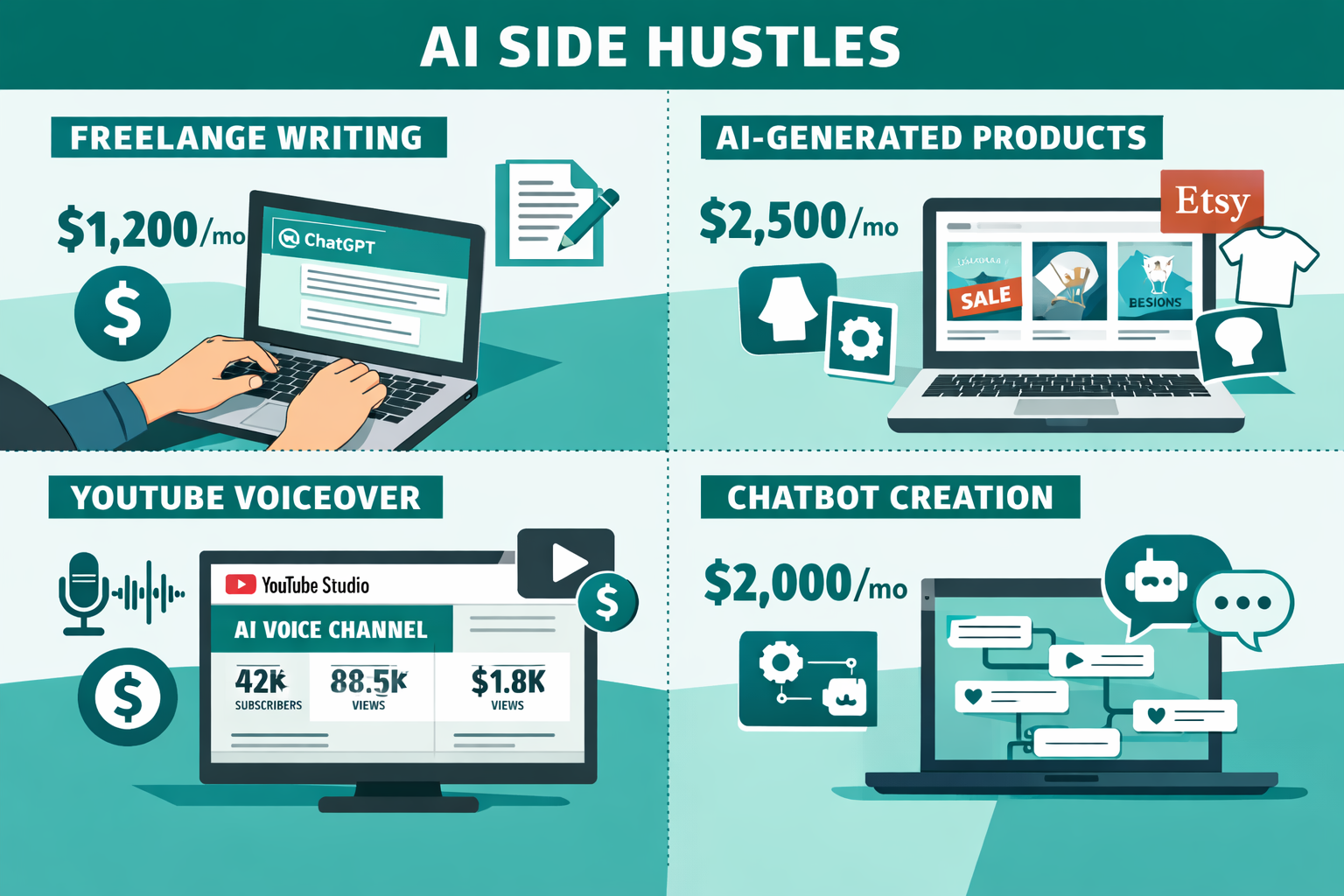
The best beginner-friendly AI side hustles are ones with low startup costs, existing demand, and a clear path to your first paying customer. Here are the top options ranked by ease of entry:
| Side Hustle | Startup Cost | Time to First Income | Earning Potential/Month |
|---|---|---|---|
| AI-assisted freelance writing | $0–$20 | 1–2 weeks | $500–$3,000 |
| AI-generated digital products | $0–$30 | 2–4 weeks | $300–$2,000 |
| AI chatbot setup for businesses | $0–$50 | 3–6 weeks | $500–$3,000 |
| Faceless YouTube (AI voiceover) | $0–$20 | 4–8 weeks | $200–$2,000 |
| AI social media content packages | $0–$20 | 1–2 weeks | $400–$2,500 |
| AI-powered print-on-demand | $0 | 2–4 weeks | $200–$1,500 |
Income estimates are based on common freelancer reports and platform data as of early 2026. Results vary based on effort, niche, and platform.
Choose AI writing if you’re comfortable editing text and want the fastest path to income.
Choose digital products if you prefer passive income and don’t mind slower initial growth.
Choose chatbot setup if you’re slightly more tech-comfortable and want higher per-project rates.
How to Start an AI Freelance Writing Business
AI-assisted freelance writing is one of the fastest ways to earn money online in 2026. You use tools like ChatGPT or Claude to draft content, then edit, fact-check, and refine it to meet client standards. Clients pay for your time, judgment, and quality control — not just the raw output.
Step-by-step process:
- Pick a niche. Focus on one industry (real estate, SaaS, health, finance). Niche writers charge more and get hired faster.
- Set up a profile. Create accounts on Fiverr and Upwork. Write a clear bio explaining what you write and for whom.
- Build 3 samples. Use ChatGPT to draft them, then edit heavily. Post them on a free portfolio site like Journo Portfolio or Contently.
- Price your work. Start at $50–$100 per article (500–800 words) and raise rates as reviews accumulate.
- Deliver and refine. Always run AI output through a grammar tool (Grammarly works fine) and check facts manually.
Common mistake: Submitting raw AI output without editing. Clients notice, and it damages your reputation. The editing step is what you’re actually being paid for.
Can You Really Make Money Selling AI-Generated Digital Products?
Yes — selling AI-generated digital products is a legitimate income stream in 2026, but it works best when the products solve a specific problem. Generic AI art or random prompt packs don’t sell well. Targeted products do.
What sells:
- Canva templates designed with AI-assisted layouts (sold on Etsy or Creative Market)
- AI-generated coloring books and activity books (sold on Amazon KDP)
- Prompt packs for specific use cases (marketing, journaling, business planning)
- AI-written planners, workbooks, and guides (sold on Gumroad or Payhip)
- Midjourney art prints in specific niches (boho nursery, minimalist office, pet portraits)
How to get started on Etsy:
- Open a free Etsy seller account.
- Research what’s already selling using the search bar and tools like Everbee or Sale Samurai.
- Create 5–10 products in one niche using Canva AI, Midjourney, or ChatGPT.
- Write keyword-rich titles and descriptions.
- Price between $3–$15 for most digital downloads.
Edge case: Etsy updated its AI disclosure policy in 2024. Sellers must tag AI-assisted products accurately. Failing to do so risks account suspension.
How to Build and Sell AI Chatbots for Small Businesses
Small businesses — local restaurants, salons, real estate agents, law firms — increasingly want chatbots to handle FAQs, bookings, and lead capture. Most of them have no idea how to build one. That’s the opportunity.
Tools you need:
- ManyChat or Voiceflow (both have free tiers and beginner-friendly interfaces)
- ChatGPT to write the chatbot scripts and conversation flows
- Zapier to connect the chatbot to email lists or booking systems (optional but valuable)
How to price it:
- Basic FAQ chatbot: $300–$500 one-time setup
- Full lead capture + booking bot: $500–$1,200 one-time setup
- Monthly maintenance retainer: $50–$150/month
Getting clients: Cold outreach works here. Search Google for local businesses with no chatbot on their website. Send a short, specific email explaining what a chatbot would do for their business. Offer a free demo build for the first client to get a testimonial.
Realistic timeline: Most beginners close their first client within 4–6 weeks of consistent outreach.
What Is a Faceless YouTube Channel and How Does AI Make It Possible?
A faceless YouTube channel publishes videos without showing the creator on camera. AI tools now handle voiceovers, scripts, and even basic video editing, making this accessible to people who don’t want to appear on screen.
The workflow:
- Pick a niche with strong search demand (personal finance, history, true crime, productivity).
- Use ChatGPT to write a video script (800–1,500 words for a 7–12 minute video).
- Use ElevenLabs or Murf AI to generate a natural-sounding voiceover.
- Use Pictory or InVideo AI to match stock footage to the script automatically.
- Add captions with CapCut (free) and upload to YouTube.
Monetization paths:
- YouTube AdSense (requires 1,000 subscribers and 4,000 watch hours)
- Affiliate links in video descriptions (faster income)
- Sponsorships once the channel grows
Honest expectation: AdSense income takes 3–6 months to kick in. Affiliate income can start much sooner. This is a medium-term hustle, not a quick win.
How to Offer AI Social Media Content Packages
Businesses and personal brands need consistent social media content but rarely have time to create it. Offering done-for-you content packages is one of the AI side hustles that actually work in 2026 because demand is high and the barrier to entry is low.
What a basic package looks like:
- 12 social media captions per month (3 per week)
- 4 short-form video scripts (for Reels or TikTok)
- 8 Canva graphics using AI-assisted templates
- Delivered via Google Drive or Notion
Pricing: $300–$800/month per client, depending on platform count and content volume.
Tools: ChatGPT for captions and scripts, Canva AI for graphics, Buffer or Later for scheduling (optional add-on service).
Getting clients: Start with local businesses or personal brands in your network. One happy client leads to referrals fast in this space.
What Are the Biggest Mistakes Beginners Make with AI Side Hustles?
The most common mistake is trying to do everything at once. Beginners often sign up for five platforms, test three different hustles, and end up with no traction on any of them.
Other mistakes to avoid:
- Skipping the editing step. Raw AI output is rarely client-ready. Always review and refine.
- Ignoring platform rules. Etsy, Upwork, and YouTube all have AI disclosure or usage policies. Read them.
- Underpricing to get clients. Very low prices attract difficult clients and signal low quality. Start at a fair rate.
- Choosing a niche with no demand. Validate before creating. Search Etsy, Fiverr, or YouTube to confirm people are already buying similar things.
- Giving up too early. Most AI side hustles take 30–90 days to generate consistent income. Consistency matters more than speed.
FAQ
Q: Do I need any technical skills to start an AI side hustle?
No. Most beginner-friendly AI side hustles — writing, digital products, social media content — require only basic computer skills. Chatbot building has a slightly steeper learning curve but most platforms have drag-and-drop interfaces.
Q: Are AI side hustles legal?
Yes, using AI tools to produce work for clients is legal. However, you must follow platform-specific rules about disclosure and cannot claim AI-generated content is entirely human-made when a client specifically asks.
Q: How much can a beginner realistically earn in the first 3 months?
A beginner who picks one hustle and works consistently (10–15 hours per week) can realistically earn $300–$1,000/month by month two or three. Results vary based on niche, effort, and platform choice.
Q: Which AI tools are free to start with?
ChatGPT (free tier), Canva (free tier), ElevenLabs (free tier with limited credits), Pictory (trial available), and ManyChat (free tier) all allow beginners to start without spending money.
Q: Can I do AI side hustles while working a full-time job?
Yes. Most of these hustles can be managed in 1–2 hours per day. Freelance writing and social media packages are especially flexible because you control the deadlines.
Q: Do I have to disclose that I used AI to create the work?
It depends on the platform and client. Etsy requires AI disclosure. Some clients on Upwork specifically request no AI use. Always read the terms and ask the client if you’re unsure.
Q: What’s the fastest AI side hustle to earn money from?
AI-assisted freelance writing on Fiverr or Upwork is typically the fastest. With a polished profile and a few samples, some beginners land their first order within a week.
Q: Is print-on-demand with AI designs still worth it in 2026?
It’s competitive but still viable in specific niches. Broad, generic designs don’t sell. Focused niches (dog breeds, specific hobbies, regional humor) still perform well.
Q: Do I need to form a business or LLC?
Not to start. Many people begin as sole proprietors. Once income grows consistently, consult a local accountant about the best structure for your situation.
Q: What if a client asks me to redo work I made with AI?
Revisions are part of freelancing regardless of the tools used. Build one free revision into your pricing and charge for additional rounds. Good communication upfront reduces revision requests significantly.
Conclusion: Your Next Steps
The AI side hustles that actually work in 2026 share one thing in common: they deliver real value to real people. AI is the tool, not the product.
Here’s what to do this week:
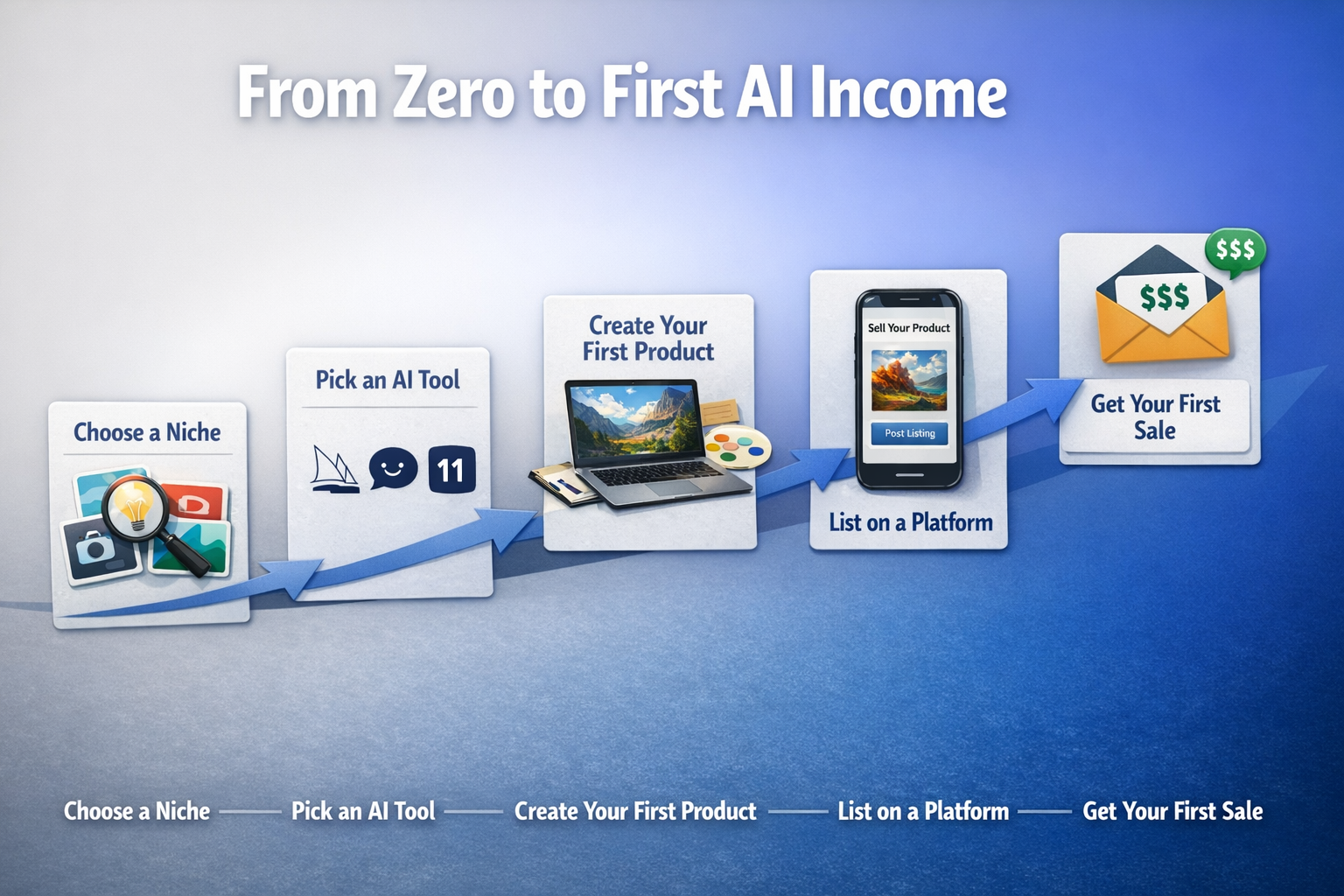
- Pick one hustle from this guide that matches your current skills and interests.
- Set up one platform account (Fiverr, Etsy, or Upwork depending on your choice).
- Create 2–3 samples using free AI tools and post them to a simple portfolio.
- Send your first pitch or list your first product within 7 days.
- Commit to 60 days before evaluating whether it’s working.
The income is real. The tools are accessible. The only thing standing between a beginner and their first AI-powered paycheck is the decision to start.