Quick Answer: Passive income is money earned with little ongoing effort after an initial setup. For beginners in 2026, the most accessible starting points are affiliate marketing, selling digital products, dividend investing, and print-on-demand stores. Most options cost little to nothing to start and can generate $100–$1,000/month within 6–12 months with consistent effort.
Key Takeaways
- Passive income is not “no work” — it requires upfront time, effort, or money, then earns with minimal ongoing input.
- Beginners should start with one income stream, not five at once.
- Digital products (eBooks, templates, courses) are among the lowest-cost, highest-margin options available in 2026.
- Affiliate marketing is free to start and works well alongside a blog, YouTube channel, or social media account.
- Dividend investing requires capital but is one of the most reliable long-term passive income strategies.
- Print-on-demand requires zero inventory and is beginner-friendly for creative types.
- Realistic income expectations: most beginners earn their first $100–$500/month within 6–12 months.
- Automation tools, AI writing assistants, and no-code platforms have made starting easier than ever in 2026.
- Taxes apply to passive income — track earnings from day one.
- Consistency matters more than perfection. Start small, stay consistent, and scale.
What Is Passive Income and Is It Really Possible for Beginners?
Passive income is money that continues to come in after the initial work is done. It’s not a get-rich-quick scheme — but it is a realistic goal for beginners who are willing to put in early effort.
Think of it like planting a tree. You dig, water, and tend to it for months. Eventually, it produces fruit without much daily attention. The same logic applies to a digital product you create once and sell repeatedly, or a blog post that earns affiliate commissions for years.
Who this works for:
- Side hustlers with 5–10 hours per week to invest upfront
- Freelancers who want income that doesn’t stop when they stop working
- Stay-at-home parents, students, or anyone wanting flexible income from home
- People with a small amount of savings to invest ($500–$5,000)
Who should adjust expectations:
- Anyone expecting income in week one (most streams take 3–12 months to gain traction)
- People unwilling to learn new tools or create any content
Top Passive Income Ideas for Beginners (2026 Guide): The Best Starting Points
The best passive income ideas for beginners in 2026 balance low startup cost, manageable learning curves, and real earning potential. Here are the most beginner-friendly options ranked by ease of entry.
1. Affiliate Marketing
Promote other companies’ products and earn a commission for each sale made through your unique link. No product creation, no customer service, no inventory.
How to start:
- Choose a niche (fitness, personal finance, tech, parenting, etc.)
- Join affiliate programs: Amazon Associates, ShareASale, Impact, or niche-specific programs
- Create content — a blog, YouTube channel, or social media account — that recommends products naturally
- Add your affiliate links to relevant content
- Drive traffic through SEO, Pinterest, or short-form video
Realistic earnings: $100–$3,000/month after 6–18 months, depending on traffic and niche. High-ticket affiliate programs (software, courses) pay $50–$500 per sale.
Common mistake: Promoting too many unrelated products. Stick to one niche and build trust with your audience first.
2. Selling Digital Products
Create a product once — an eBook, template, Notion dashboard, Lightroom preset, or mini-course — and sell it repeatedly with no restocking or shipping.
Best platforms in 2026:
- Gumroad — simple, beginner-friendly, free to start
- Etsy — strong organic traffic for templates and printables
- Payhip — no monthly fees, good for eBooks and courses
- Stan Store — popular for creators selling directly via social media links
Realistic earnings: $200–$2,000/month once a product gains traction. A well-optimized Etsy template shop can earn $500–$1,500/month passively after the initial build.
Choose this if: You have a skill others want to learn or a problem you’ve already solved for yourself.
3. Print-on-Demand (POD)
Design graphics for t-shirts, mugs, tote bags, and phone cases. A POD company prints and ships each item when a customer orders — you never touch inventory.
Top platforms: Redbubble, Merch by Amazon, Printful (paired with Etsy or Shopify), Printify.
Realistic earnings: $50–$500/month as a side earner. Scaling requires volume — successful POD sellers often have hundreds of designs live.
Common mistake: Uploading 10 generic designs and waiting. Success in POD requires research into trending niches and consistent uploading.
4. Dividend Investing
Buy shares in companies or ETFs (exchange-traded funds) that pay regular dividends. Your money works for you while you sleep.
How to start:
- Open a brokerage account (Fidelity, Charles Schwab, or a platform available in your country)
- Research dividend ETFs like SCHD, VYM, or VIG (U.S.-based examples)
- Invest consistently, even small amounts monthly
- Reinvest dividends early on to compound growth
Realistic earnings: With $10,000 invested at a 4% dividend yield, that’s roughly $400/year or $33/month. This strategy rewards patience and capital.
Who this is for: Anyone with savings they won’t need for 5+ years. Not ideal if you need income quickly.
5. YouTube Ad Revenue and Sponsorships
Create videos on a topic you know well. Once a channel reaches YouTube’s monetization threshold (currently 1,000 subscribers and 4,000 watch hours), ad revenue begins. Sponsorships can start even earlier.
Realistic earnings: Small channels earn $1–$5 per 1,000 views from ads. A channel with 50,000 monthly views might earn $50–$250/month from ads alone, plus sponsorship income.
This takes time — most channels take 12–24 months to become meaningfully passive. But older videos keep earning indefinitely.
6. Blogging with SEO
Write articles optimized for search engines. Once ranked, a blog post earns traffic — and affiliate or ad revenue — for months or years without updates.
How to monetize a blog:
- Affiliate links embedded in articles
- Display ads (Mediavine, Raptive, Google AdSense)
- Digital product sales
- Sponsored posts
Realistic earnings: A blog with 30,000–50,000 monthly visitors can earn $1,000–$5,000/month from combined monetization. Getting there typically takes 12–24 months of consistent publishing.
How Much Can Beginners Realistically Earn?
Most beginners earn their first passive income within 3–6 months, but meaningful monthly income usually takes 6–18 months. Here’s a realistic breakdown:
| Income Stream | Startup Cost | Time to First $$ | Monthly Potential (Year 1) |
|---|---|---|---|
| Affiliate Marketing | $0–$100 | 3–9 months | $100–$1,000 |
| Digital Products | $0–$50 | 1–3 months | $200–$2,000 |
| Print-on-Demand | $0 | 1–4 months | $50–$500 |
| Dividend Investing | $500–$5,000+ | Immediate (small) | $20–$200 |
| YouTube | $0–$500 (equipment) | 12–24 months | $50–$500 |
| Blogging | $50–$150/year | 12–24 months | $100–$2,000 |
💡 Key insight: Combining two streams — for example, a blog with affiliate links AND a digital product — accelerates income significantly without doubling the workload.
Step-by-Step: How to Start Your First Passive Income Stream in 2026
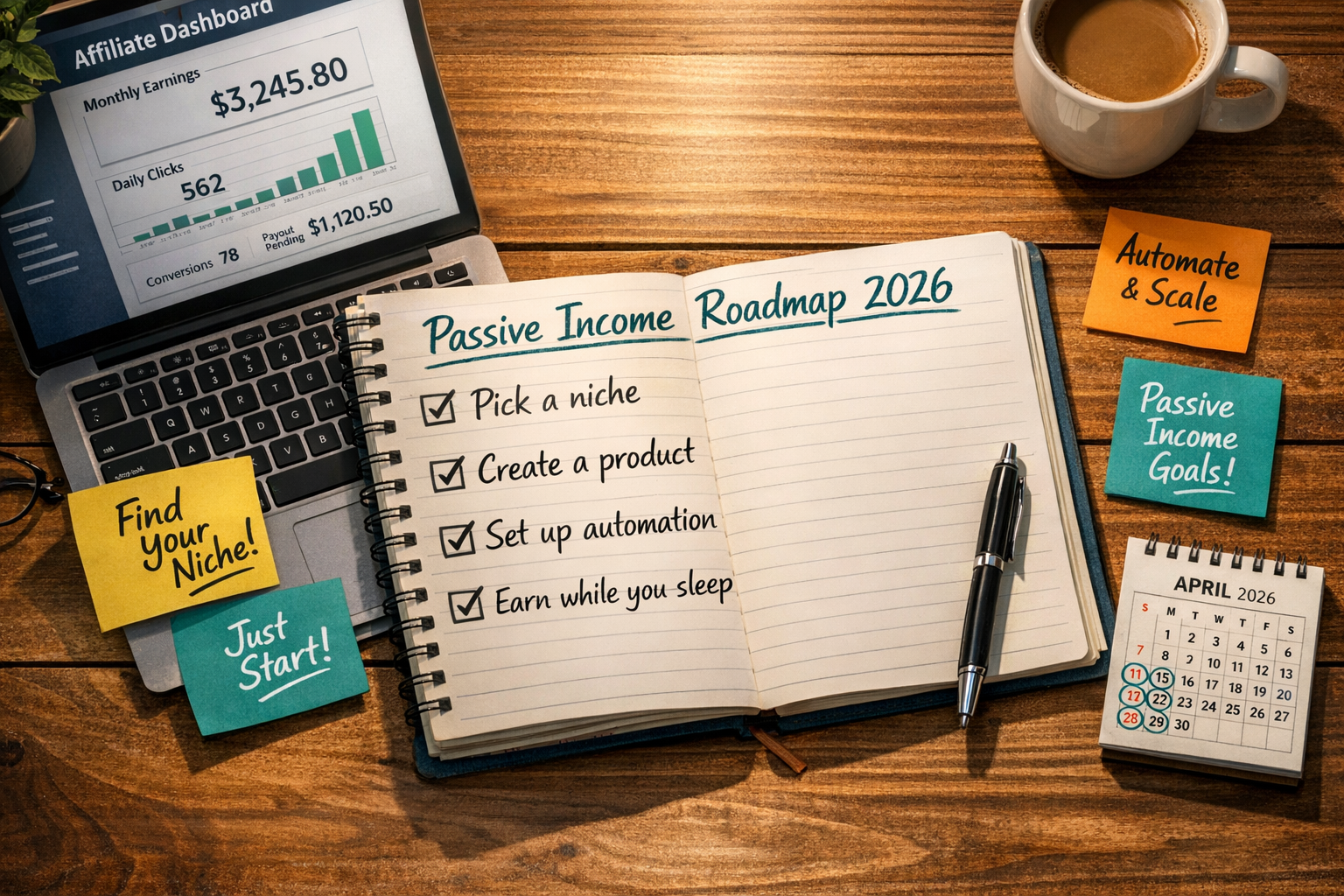
Starting is the hardest part. Here’s a practical roadmap any beginner can follow.
Step 1: Choose one income stream.
Pick based on your skills and available time. Have a skill to teach? Sell a digital product. Love writing? Start a blog. Have savings? Try dividend investing.
Step 2: Validate before you build.
Before creating a full course or eBook, check if people are already searching for or buying similar things. Use Google Trends, Etsy search, or Amazon bestseller lists.
Step 3: Set up your platform.
- Blog: WordPress.org + a hosting plan (~$3–$10/month)
- Digital product: Gumroad or Etsy (free to start)
- Investing: Open a brokerage account (free)
- POD: Redbubble or Merch by Amazon (free)
Step 4: Create your first asset.
Don’t aim for perfect. A 10-page eBook solving one specific problem beats a 100-page guide that takes a year to finish.
Step 5: Drive traffic.
- Pinterest for blogs and Etsy shops
- Short-form video (TikTok, Instagram Reels, YouTube Shorts) for product promotion
- SEO for long-term organic traffic
Step 6: Automate and optimize.
Use email marketing tools (Mailchimp, ConvertKit) to automate follow-ups. Use scheduling tools for social posts. Once a system works, scale it.
Step 7: Track income and taxes.
Use a simple spreadsheet or free tool like Wave to track earnings. Passive income is taxable — set aside 20–30% depending on your country’s rules.
Common Mistakes Beginners Make with Passive Income
Knowing what not to do saves months of wasted effort.
- Trying to do everything at once. Spreading across five streams before mastering one leads to mediocre results in all of them.
- Expecting fast results. Most passive income streams take 6–18 months to become meaningful. Quitting at month two is the most common failure point.
- Ignoring SEO. Content without search optimization gets no organic traffic. Learn basic keyword research early.
- Skipping the audience-building step. Even one email subscriber list of 500 engaged people can generate more income than 5,000 random social media followers.
- Not reinvesting early earnings. The first $200/month should go back into tools, ads, or better equipment — not lifestyle spending.
Frequently Asked Questions
Q: Can I start passive income with no money?
Yes. Affiliate marketing, print-on-demand, and creating free content (blog, YouTube, social media) all cost nothing to start. A domain name and hosting for a blog costs roughly $50–$100/year, which is the most common small investment beginners make.
Q: How long does it take to make $1,000/month passively?
For most beginners, 12–24 months is a realistic timeline to reach $1,000/month, assuming consistent effort. Digital products and affiliate marketing tend to reach this milestone faster than blogging or YouTube.
Q: Is passive income taxable?
Yes. In most countries, passive income — whether from affiliate commissions, digital product sales, dividends, or ad revenue — is taxable. Consult a local tax professional or accountant to understand your obligations.
Q: What’s the easiest passive income idea for a complete beginner?
Selling digital products (like Canva templates or simple eBooks) on Gumroad or Etsy is often the easiest entry point. The setup is simple, the cost is near zero, and the first sale can happen within days if the product solves a real problem.
Q: Do I need a large social media following to succeed?
No. Many successful passive income earners use SEO-driven blogs or Etsy shops that get traffic from search engines, not social media. A following helps but isn’t required.
Q: What tools do beginners need?
At minimum: a free Canva account (for design), a Gumroad or Etsy account (for selling), and Google Docs (for writing). More advanced setups add email marketing tools and a personal website.
Q: Is affiliate marketing still worth it in 2026?
Yes. Affiliate marketing remains one of the most scalable passive income models. AI-assisted content creation and short-form video have opened new channels for affiliate promotion, making it more accessible than ever.
Q: Can I do passive income while working a full-time job?
Absolutely. Most passive income streams are built in the evenings and weekends. Starting with 5–10 hours per week is enough to build meaningful momentum over 6–12 months.
Q: What’s the biggest risk with passive income?
Platform dependency is the biggest risk. If your entire income relies on one platform (Amazon, Etsy, YouTube) and that platform changes its rules, your income can drop overnight. Diversify across at least two streams once you’re established.
Q: How do I know which passive income idea is right for me?
Match your resources to the model: time-rich but cash-poor? Start with affiliate marketing or digital products. Cash-rich but time-poor? Consider dividend investing. Creative? Try POD or YouTube.
Conclusion: Your Next Steps Start Today
The best passive income ideas for beginners in 2026 are more accessible than ever — but they still require real effort, patience, and a clear starting point. The goal isn’t to find a magic shortcut. It’s to build one reliable income stream, learn from it, and gradually add more.
Here’s what to do this week:
- Pick one income stream from this guide that matches your skills and time.
- Spend 30 minutes researching what’s already working in that niche (Etsy search, Google Trends, YouTube).
- Set up your platform (it takes less than an hour for most options).
- Create your first asset — however small — and publish it.
- Commit to showing up consistently for 90 days before evaluating results.
Passive income isn’t passive at the start. But for those who build it patiently, it becomes one of the most powerful financial tools available — income that works even when you’re not.