Last updated: March 24, 2026
Quick Answer: Easy online income ideas for students and beginners include freelancing, selling digital products, taking paid surveys, affiliate marketing, and print-on-demand. Most require zero upfront investment, can be started within a day, and can realistically earn anywhere from $50 to $1,000+ per month depending on the method and time invested.
Key Takeaways
- Freelancing (writing, graphic design, data entry) is one of the fastest ways to earn real money online with no startup cost.
- Platforms like Fiverr, Upwork, and Toptal connect beginners with paying clients immediately.
- Affiliate marketing and digital product sales can generate passive income over time, but require consistent effort upfront.
- Paid surveys and microtask sites (Swagbucks, Amazon Mechanical Turk) offer low but reliable entry-level earnings.
- Print-on-demand stores require no inventory and can be launched for free on platforms like Redbubble or Printful + Etsy.
- Realistic beginner income ranges from $100 to $500/month in the first 3 months, scaling with skill and consistency.
- Choosing one method and sticking with it for 60–90 days beats jumping between ideas.
- Scams are common in this space — any “opportunity” that requires upfront payment or promises overnight riches should be avoided.
What Are the Best Easy Online Income Ideas for Students and Beginners?
The best starting points are methods that need no money to begin, can be learned quickly, and have a clear path to first payment. For most beginners, that means freelancing, microtasks, or selling something simple online.
Here’s a quick overview of the top options ranked by how fast a beginner can realistically earn their first dollar:
| Method | Time to First Earnings | Startup Cost | Income Potential (Monthly) |
|---|---|---|---|
| Paid surveys / microtasks | 1–3 days | $0 | $20–$150 |
| Freelance writing / data entry | 1–2 weeks | $0 | $200–$2,000+ |
| Print-on-demand | 1–4 weeks | $0–$20 | $50–$500+ |
| Affiliate marketing | 1–3 months | $0–$100 | $100–$5,000+ |
| Selling digital products | 2–6 weeks | $0–$50 | $100–$3,000+ |
| Online tutoring | 1–2 weeks | $0 | $15–$50/hr |
Choose freelancing if the goal is fast, reliable income. Choose affiliate marketing or digital products if building something that earns while sleeping is the priority.
How Does Freelancing Work for Beginners?
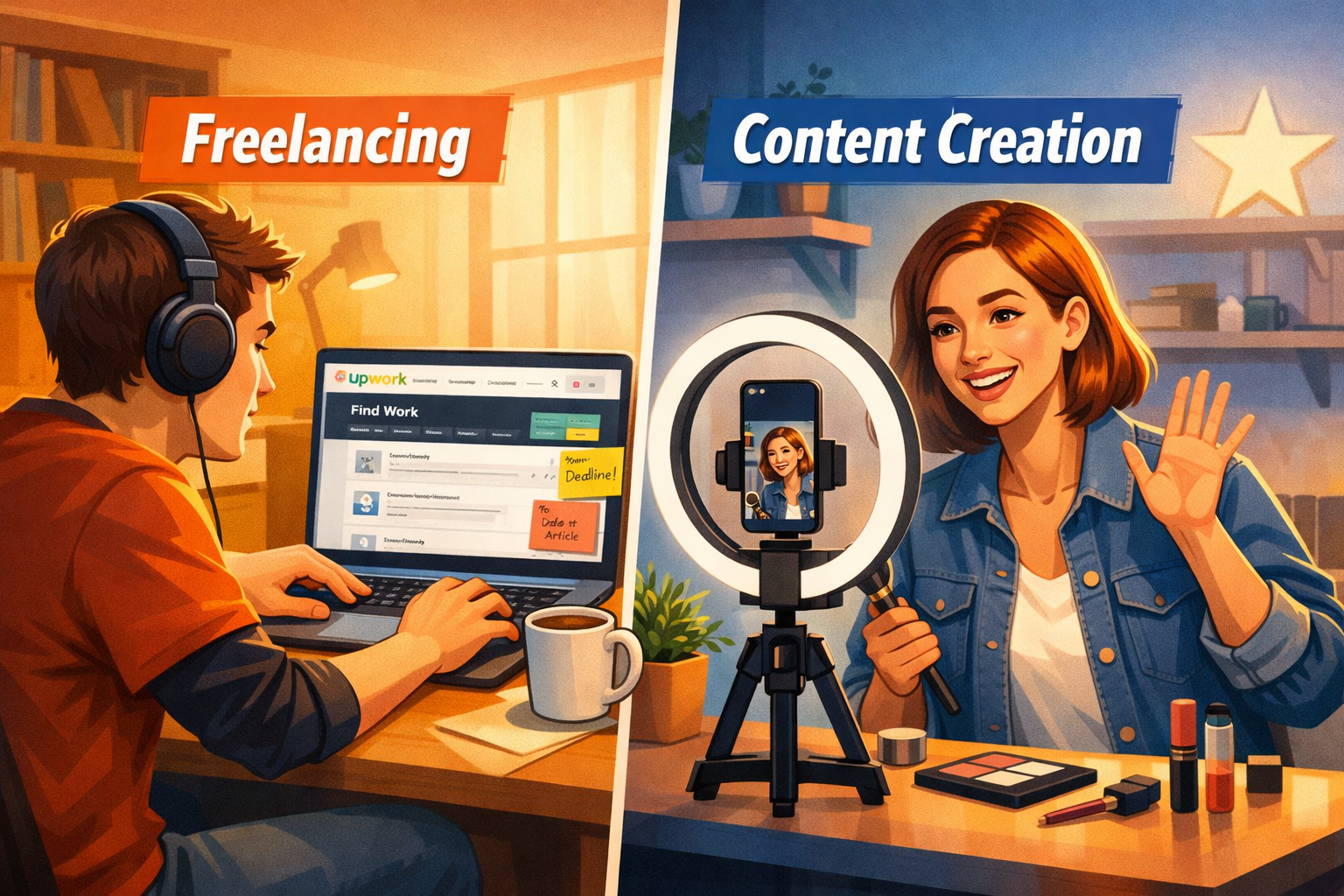
Freelancing means offering a skill as a service to clients online — and beginners can start without a portfolio or experience if they pick the right entry-level skills. Platforms handle client discovery, contracts, and payments, so the only job is to deliver good work.
Best beginner-friendly freelance skills:
- Data entry and virtual assistance — No special training needed. Clients pay $10–$20/hr for organized, reliable help.
- Copywriting and blog writing — If writing comes naturally, this scales fast. Rates start around $0.03–$0.10/word for beginners and rise quickly with a portfolio.
- Social media management — Small businesses need help posting and responding. Basic knowledge of Instagram or Facebook is enough to start.
- Graphic design — Tools like Canva make this accessible. Fiverr has thousands of active buyers looking for logo design, social media graphics, and more.
- Transcription — Sites like Rev.com and TranscribeMe pay per audio minute. No experience required; just good listening and typing speed.
How to land the first client:
- Create a free profile on Fiverr or Upwork.
- Pick one service to offer — don’t list ten things at once.
- Write a clear, specific gig description that explains exactly what the client gets.
- Set a low introductory price to build reviews (raise rates after 5–10 completed jobs).
- Deliver on time, communicate clearly, and ask for a review after each project.
Common mistake: Beginners often create vague gig titles like “I will do writing.” Specific titles like “I will write a 500-word SEO blog post for your small business” attract far more buyers.
Can Beginners Really Make Money With Paid Surveys and Microtasks?
Yes — but with realistic expectations. Paid surveys and microtask platforms are the easiest entry point for anyone with zero skills or experience, but they’re not a path to significant income. Think of them as “practice money” while building bigger skills on the side.
Legitimate platforms worth using:
- Swagbucks — Earn points for surveys, watching videos, and shopping online. Points convert to gift cards or PayPal cash.
- Amazon Mechanical Turk (MTurk) — Short digital tasks (image labeling, data verification) that pay $0.01–$1.00 each. Consistent workers can earn $5–$15/day.
- Prolific — Academic research surveys that pay better than average ($6–$12/hr is common according to Prolific’s published rate data).
- UserTesting — Pay $10 per 20-minute website usability test. Slots fill quickly but the hourly rate is strong.
Realistic income: $50–$150/month is achievable with daily effort. It’s supplemental income, not a replacement for a job.
Watch out for: Any survey site that asks for payment to join, promises $500/day, or requires a credit card number. Legitimate platforms are always free to join.
What Is Affiliate Marketing and How Can a Beginner Start?
Affiliate marketing means promoting another company’s product and earning a commission when someone buys through a unique referral link. It’s one of the most popular easy online income ideas for students and beginners because it requires no product creation and no customer service.
How it works in simple steps:
- Join an affiliate program (Amazon Associates, ShareASale, or a brand’s own program).
- Get a unique tracking link for a product.
- Share that link through a blog, YouTube video, TikTok, or social media post.
- Earn a commission (typically 3%–50% depending on the product category) when someone clicks and buys.
Best platforms for beginners:
- Amazon Associates — Easiest to join. Commissions are low (1%–10%) but product selection is massive.
- ShareASale — Thousands of brands across every niche. Many pay 15%–30% commissions.
- ClickBank — Digital products with high commissions (40%–75%), but quality varies so vetting products matters.
Realistic timeline: Most beginners see their first commission within 60–90 days if they’re consistently creating content. Income grows as traffic grows.
Choose affiliate marketing if: There’s already an audience (even a small one) on social media, a blog, or YouTube. Without an audience, building one first is step zero.
How Can Students Sell Digital Products Online?
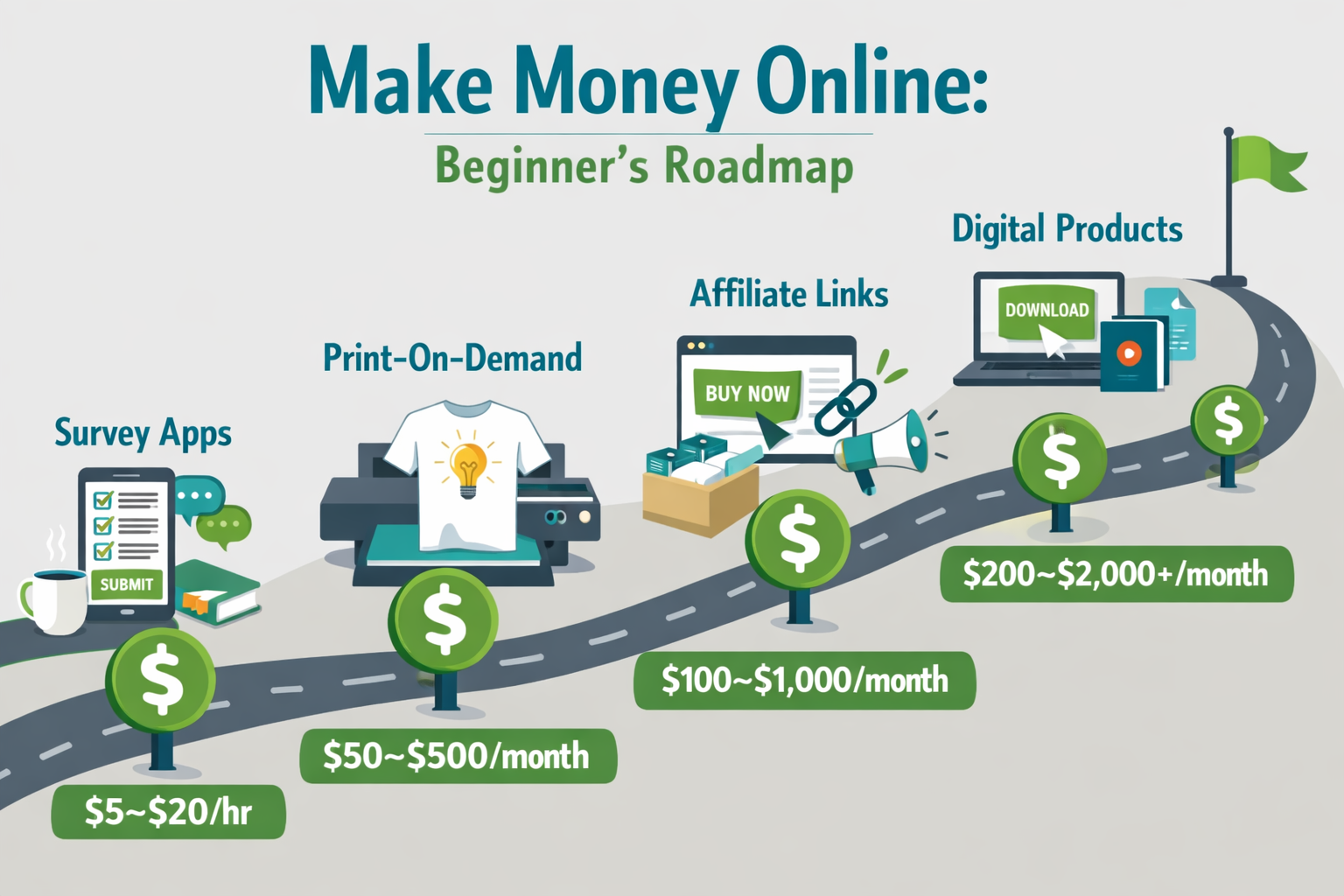
Selling digital products is one of the smartest easy online income ideas for students and beginners because the product is created once and sold unlimited times with no shipping, no inventory, and no additional work per sale.
Popular digital products beginners can create:
- Notion templates — Productivity templates for students, freelancers, or entrepreneurs. Sell on Gumroad or Etsy for $5–$30 each.
- Canva templates — Social media post templates, resume designs, or presentation decks. High demand on Etsy.
- Study guides and notes — Students can sell their own class notes on platforms like Stuvia or Nexus Notes.
- eBooks and guides — A 20-page PDF on a topic someone knows well (budgeting, fitness, a hobby) can sell for $7–$27.
- Lightroom presets — Photo editing presets for Instagram-style photos are popular among content creators.
Where to sell:
- Gumroad — Free to start. Takes a small percentage per sale. Great for first-timers.
- Etsy — Built-in traffic. Small listing fee ($0.20/item) but millions of active buyers.
- Payhip — Zero transaction fees on the free plan. Good for beginners.
Realistic income: Highly variable. A well-designed Notion template on Etsy with good SEO can earn $100–$500/month passively after the initial setup work.
Is Print-on-Demand a Good Beginner Online Income Idea?
Print-on-demand (POD) is a solid option for creative beginners who want to sell physical products without managing inventory. A design is uploaded to a platform, and when a customer orders, the platform prints and ships the item automatically.
How to start:
- Create a free account on Redbubble, Merch by Amazon, or Printful (connected to an Etsy shop).
- Design simple graphics using Canva or Adobe Express — text-based designs with clever phrases sell well.
- Upload designs to multiple products (t-shirts, mugs, tote bags, phone cases).
- Optimize product titles and descriptions with relevant keywords.
- Share products on Pinterest or TikTok to drive traffic.
Income expectations: Most beginners earn $0–$50 in the first month while building a catalog. Sellers with 50+ designs and good SEO commonly report $100–$500/month. A few niches (pet lovers, teachers, nurses) consistently outperform others.
Honest caveat: POD is a slow build. It rewards patience and volume — more designs generally means more sales.
What Are the Fastest Ways to Earn Your First $100 Online?
For a complete beginner who needs money quickly, the fastest path combines a few of these easy online income ideas for students and beginners:
7-day action plan to earn the first $100:
- Day 1: Sign up for Swagbucks, Prolific, and UserTesting. Complete profile surveys to qualify for more tasks.
- Day 2: Create a Fiverr profile offering one specific service (data entry, proofreading, or social media posts).
- Day 3–4: Message 10 local small businesses on Instagram offering to manage their social media for $50–$100/month.
- Day 5: List one digital product on Gumroad — even a simple checklist or template.
- Day 6–7: Spend 2 hours/day on Prolific surveys and MTurk tasks to stack small earnings.
This approach combines fast money (surveys, microtasks) with medium-term income (freelancing, digital products) so there’s something coming in from multiple directions.
What Mistakes Do Beginners Make When Trying to Earn Online?
Most beginners fail not because the methods don’t work, but because of a few predictable errors:
- Trying too many things at once. Spreading effort across five platforms in week one guarantees mediocre results everywhere. Pick one method, run it for 60 days, then add a second.
- Quitting too early. Affiliate marketing and digital products take months to gain traction. Expecting results in two weeks leads to unnecessary frustration.
- Falling for scams. If an “opportunity” requires paying to access jobs, buying a starter kit, or promises $500/day with no effort — it’s a scam. Legitimate platforms are free to join.
- Ignoring quality. On freelance platforms, one bad review can tank visibility. Delivering excellent work on the first few jobs matters more than speed.
- Skipping the basics of online safety. Never share banking details, Social Security numbers, or passwords with clients or platforms that don’t have clear privacy policies.
FAQ: Easy Online Income Ideas for Students and Beginners
Q: How much can a complete beginner realistically earn online per month?
A: In the first 1–3 months, $100–$300/month is a realistic target using surveys, microtasks, and entry-level freelancing. With consistent effort and skill-building, $500–$1,500/month is achievable within 6 months.
Q: Do I need any skills to start making money online?
A: No specialized skills are required to start with surveys, data entry, or microtasks. Skills like writing, design, or video editing increase earning potential significantly and can be learned free on YouTube or Coursera.
Q: Is it safe to give my PayPal or bank details to online income platforms?
A: Only share payment details with established, well-reviewed platforms (PayPal, Stripe, Payoneer). Research any platform before signing up. Never wire money or share banking credentials with individual clients directly.
Q: What’s the best platform for a student with no experience?
A: Fiverr for services, Gumroad for digital products, and Prolific for surveys are the most beginner-friendly options with low barriers to entry and legitimate payment systems.
Q: How many hours per week does it take to earn $500/month online?
A: Roughly 10–15 hours/week of focused work is a reasonable estimate for reaching $500/month through freelancing within 3–6 months. Passive income methods (affiliate marketing, digital products) require more upfront time but less ongoing effort.
Q: Can students do this while studying full-time?
A: Yes. Most of these methods are flexible and can be done in 1–2 hour blocks. Freelancing and digital products are especially compatible with student schedules because there are no fixed hours.
Q: Are online income platforms available worldwide?
A: Most major platforms (Fiverr, Upwork, Gumroad, Redbubble) are available globally, though payment options vary by country. PayPal and Payoneer cover most regions. Always check platform availability for a specific country before investing time.
Q: What’s the single best method for a beginner with no money and no skills?
A: Start with Prolific or UserTesting for immediate small earnings while learning a basic freelance skill (writing or data entry) on the side. This combination provides income now and growth potential later.
Conclusion: Start Small, Stay Consistent, Scale Smart
The best easy online income ideas for students and beginners are the ones that get started today — not the “perfect” one researched for three weeks. Every method covered here has helped real beginners earn real money, and none of them require a business degree, a big budget, or technical expertise.
Actionable next steps:
- Pick one method from this guide that matches current skills and time availability.
- Set up a profile or account on the relevant platform today — it takes less than 30 minutes.
- Commit to 60 days of consistent effort before evaluating results or switching methods.
- Reinvest early earnings into learning a higher-value skill (copywriting, SEO, video editing) to increase earning potential.
- Track income and time spent in a simple spreadsheet to understand what’s actually working.
The gap between people who earn online and those who don’t is almost never talent — it’s follow-through. Starting small and staying consistent is the strategy that works.