Imagine earning money while you sleep — without ever touching inventory, packing a single box, or investing thousands of dollars upfront. That dream is very real in 2026, and the best print on demand platforms for beginners are making it easier than ever to turn simple designs into a steady stream of passive income.
Whether you’re a freelancer looking to diversify, a stay-at-home parent seeking a side hustle, or someone who simply wants to make money online without a huge risk, print on demand (POD) is one of the most beginner-friendly business models available today.
This guide breaks down everything you need to know — from choosing the right platform to realistic earning expectations — so you can start confidently.
Key Takeaways 📌
- Print on demand requires zero upfront inventory costs — products are only made when a customer orders.
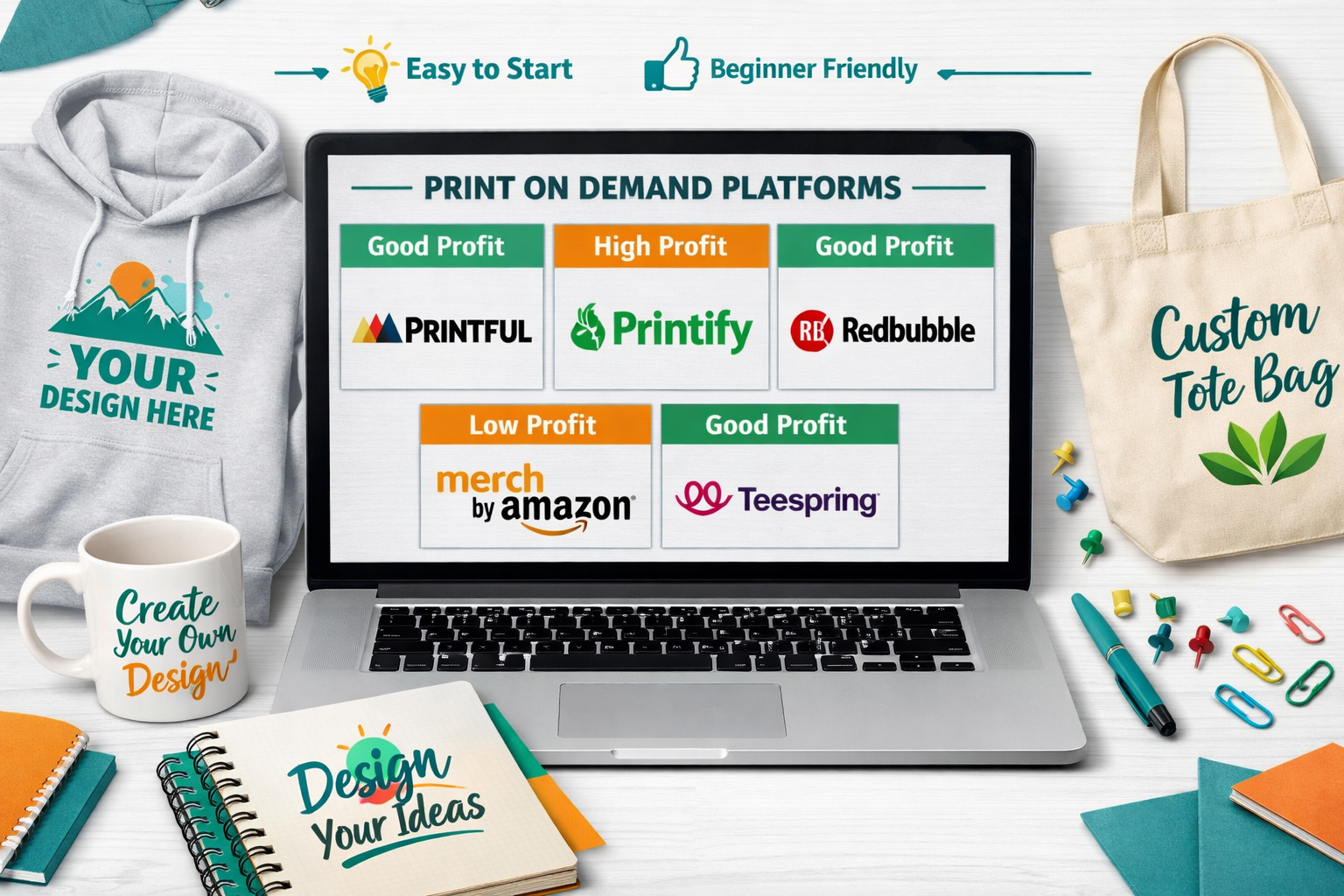
- Printful, Printify, Redbubble, Merch by Amazon, and Teespring (Spring) are among the top platforms for beginners in 2026.
- Profit margins typically range from 15% to 40%, depending on the platform and product type.
- Design quality and niche selection are the two biggest factors in your success.
- You can start earning within days of setting up your store — some platforms have built-in audiences.
What Is Print on Demand and Why It’s Perfect for Beginners
Print on demand is a business model where you upload custom designs to a platform. When a customer buys a product — like a t-shirt, mug, or phone case — the platform prints and ships it directly to the buyer. You keep the profit margin between the retail price you set and the platform’s base cost.
Why Beginners Love POD 💡
- ✅ No inventory — you never hold stock
- ✅ No upfront investment — most platforms are free to join
- ✅ No shipping hassles — the platform handles fulfillment
- ✅ Scalable — add more designs over time
- ✅ Works globally — sell to customers worldwide
“Print on demand is one of the few online business models where a complete beginner can go from zero to first sale in under a week.”
The barrier to entry is incredibly low. You don’t need a business degree, coding skills, or a warehouse. All you need is a design idea and a free account on one of the platforms below.
How to Evaluate the Best Print on Demand Platforms for Beginners
Not all POD platforms are created equal. When choosing the best print on demand platforms for beginners, consider these key factors:
| Factor | Why It Matters |
|---|---|
| Ease of use | Beginners need a simple setup process |
| Product variety | More products = more ways to earn |
| Profit margins | Higher margins mean more money per sale |
| Built-in marketplace | Some platforms bring buyers to you |
| Integration options | Connect to Etsy, Shopify, WooCommerce |
| Print quality | Poor quality leads to bad reviews and refunds |
| Shipping speed | Faster shipping = happier customers |
Keep these factors in mind as you review the platforms below.
The 5 Best Print on Demand Platforms for Beginners in 2026
1. 🖨️ Printful — Best for Quality and Integrations
Printful is widely considered the gold standard in the POD industry. It integrates seamlessly with Etsy, Shopify, WooCommerce, Amazon, and more.
Key features:
- 300+ customizable products
- High-quality printing with consistent results
- Free to use — pay only when you make a sale
- Warehousing and fulfillment services available
- Beginner-friendly mockup generator
Profit potential: Margins typically range from 20% to 35% depending on the product. A custom t-shirt with a base cost of $12 can sell for $25–$30, earning you $13–$18 per sale.
Best for: Beginners who want to connect to their own Etsy or Shopify store and build a brand.
2. 🎨 Printify — Best for Low Base Costs
Printify works similarly to Printful but gives you access to a network of global print providers, which often means lower base costs and higher profit margins.
Key features:
- 900+ products available
- Choose from multiple print providers per product
- Free plan available; Premium plan ($29/month) unlocks up to 20% discount on base prices
- Integrates with Etsy, Shopify, WooCommerce, and more
Profit potential: Margins can reach 30% to 45% on popular products when using lower-cost print providers. A custom hoodie with a $22 base cost can sell for $45–$55.
Best for: Beginners focused on maximizing profit margins and scaling quickly.
⚠️ Tip: Print quality can vary between providers on Printify. Always order a sample before listing a product.
3. 🌈 Redbubble — Best Built-In Marketplace
Redbubble is a unique platform because it has its own built-in marketplace with millions of shoppers. You don’t need a separate store — just upload your designs and Redbubble handles everything else.
Key features:
- No store setup required
- Millions of active buyers on the platform
- 70+ product types
- Artists set their own markup percentage
- Free to join
Profit potential: Most sellers set markups of 20% to 30% above the base price. Income is more passive since Redbubble drives its own traffic, but earnings per sale tend to be lower.
Best for: Beginners who want the simplest possible setup and don’t want to manage marketing.
4. 📦 Merch by Amazon — Best for Passive Income Potential
Merch by Amazon (now called Merch on Demand) lets you sell custom t-shirts, hoodies, and other products directly on Amazon — the world’s largest online marketplace.
Key features:
- Access to Amazon’s massive customer base
- Amazon handles all printing, shipping, and customer service
- No upfront costs
- Royalties paid per sale
Profit potential: Royalties typically range from $2 to $8 per shirt, depending on the price point and Amazon’s fees. Volume is the key — sellers with hundreds of designs can earn $1,000+ per month passively.
Best for: Beginners comfortable with a slower start (there’s an application/approval process) who want access to Amazon’s traffic.
📝 Note: Merch by Amazon uses a tiered system. New sellers start with 10 design slots and unlock more as they make sales.
5. 👕 Spring (formerly Teespring) — Best for Creators and Social Media
Spring is built for content creators, YouTubers, streamers, and social media influencers who want to sell merchandise directly to their audience.
Key features:
- Direct integration with YouTube, Instagram, and TikTok
- No upfront costs
- 180+ products available
- Built-in storefront
- Boosted Network helps promote your products
Profit potential: Margins vary widely — typically 20% to 40% — and depend heavily on your audience size. Creators with even a small but engaged following can generate consistent monthly income.
Best for: Beginners who already have a social media presence or content channel.
Quick Comparison Table: Best Print on Demand Platforms for Beginners
| Platform | Free Plan | Built-in Traffic | Best Integration | Avg. Margin |
|---|---|---|---|---|
| Printful | ✅ Yes | ❌ No | Etsy, Shopify | 20–35% |
| Printify | ✅ Yes | ❌ No | Etsy, Shopify | 30–45% |
| Redbubble | ✅ Yes | ✅ Yes | Standalone | 20–30% |
| Merch by Amazon | ✅ Yes | ✅ Yes | Amazon | $2–$8/sale |
| Spring | ✅ Yes | ✅ Partial | YouTube, TikTok | 20–40% |
How to Get Started: A Step-by-Step Action Plan
Getting started with POD doesn’t have to be complicated. Here’s a simple roadmap:
Step 1: Choose Your Niche 🎯
Don’t try to sell to everyone. Pick a specific audience — dog lovers, nurses, gamers, yoga enthusiasts — and create designs that speak directly to them. Niche stores consistently outperform general stores in POD.
Step 2: Create Your Designs 🖌️
You don’t need to be a professional designer. Free tools like Canva and Adobe Express make it easy to create attractive designs. Keep it simple — text-based designs and clean graphics often sell better than complex artwork.
Design tips for beginners:
- Use high-resolution files (at least 300 DPI)
- Stick to 2–3 colors for cleaner prints
- Research trending niches on platforms like Pinterest and Etsy
- Check copyright rules — never use trademarked phrases or logos
Step 3: Pick Your Platform and Set Up Your Store 🛒
Based on the comparison above, choose the platform that fits your goals. For most beginners, starting with Printify + Etsy or Redbubble is the easiest path to first sales.
Step 4: Price Your Products Strategically 💰
Use this simple formula:
Retail Price = Base Cost + Desired Profit + Platform Fees
Research competitor prices on your chosen platform. Don’t undercut too aggressively — buyers often associate very low prices with poor quality.
Step 5: Optimize Your Listings for Search 🔍
Use relevant keywords in your product titles, descriptions, and tags. Think about what your target customer would type into a search bar. Strong SEO on your listings drives organic traffic — especially on Etsy and Redbubble.
Step 6: Promote and Scale 📣
- Share products on Pinterest (great for POD traffic)
- Post behind-the-scenes content on Instagram or TikTok
- Run occasional promotions or discounts
- Add new designs consistently — more designs = more chances to sell
Realistic Earning Expectations for Beginners
Let’s be honest about what beginners can realistically expect:
| Timeline | Realistic Earnings |
|---|---|
| Month 1–2 | $0–$50 (learning phase, first sales) |
| Month 3–6 | $50–$300/month (building catalog) |
| Month 6–12 | $200–$800/month (with consistent effort) |
| Year 2+ | $500–$3,000+/month (scaled catalog) |
These numbers assume consistent design uploads, good niche selection, and basic marketing. Some sellers earn more, some less — results vary. The key is consistency over time.
Common Beginner Mistakes to Avoid ⚠️
- ❌ Uploading generic designs with no niche focus
- ❌ Ignoring SEO in product titles and descriptions
- ❌ Setting prices too low and killing your margins
- ❌ Giving up too soon — most POD stores take 3–6 months to gain traction
- ❌ Skipping product samples — always test quality before scaling
- ❌ Using copyrighted content — this can get your account banned
Conclusion: Your Next Steps Start Today
The best print on demand platforms for beginners in 2026 have never been more accessible, more feature-rich, or more beginner-friendly. Whether you choose Printful for its quality, Printify for its margins, Redbubble for its built-in traffic, Merch by Amazon for its passive potential, or Spring for its creator tools — there’s a platform that fits your goals and skill level.
Your Action Plan 🚀
- Pick one platform from this list — don’t try all five at once
- Choose a specific niche you’re genuinely interested in
- Create 5–10 designs using Canva or Adobe Express
- List your products with strong SEO-optimized titles and descriptions
- Promote on Pinterest or social media to drive early traffic
- Be consistent — add new designs every week and track what sells
The biggest mistake beginners make is waiting for the “perfect” moment. The best time to start is right now. Your first design could be live and available to buyers within the next 24 hours.