
Quick Answer: The best digital products to sell online for passive income include eBooks, online courses, templates, stock photos, music, software tools, and printables. These products require upfront effort to create but can generate ongoing revenue with little maintenance. Platforms like Gumroad, Etsy, and Teachable make it easy for beginners to start selling within days.
Key Takeaways
- Digital products have no inventory, no shipping costs, and can be sold to unlimited customers simultaneously.
- eBooks, online courses, and Canva templates are among the easiest entry points for beginners.
- Realistic starting income ranges from $100 to $1,000/month within the first 3–6 months, depending on niche, quality, and marketing effort.
- Choosing the right platform matters: Gumroad suits simple file sales, Teachable suits courses, and Etsy suits printables and templates.
- Building an email list or social media audience significantly accelerates sales growth.
- You don’t need to be a tech expert — most platforms handle payments, delivery, and customer management automatically.
- Pricing digital products between $7 and $97 tends to convert well for beginners.
- The biggest mistake beginners make is creating a product before validating demand.
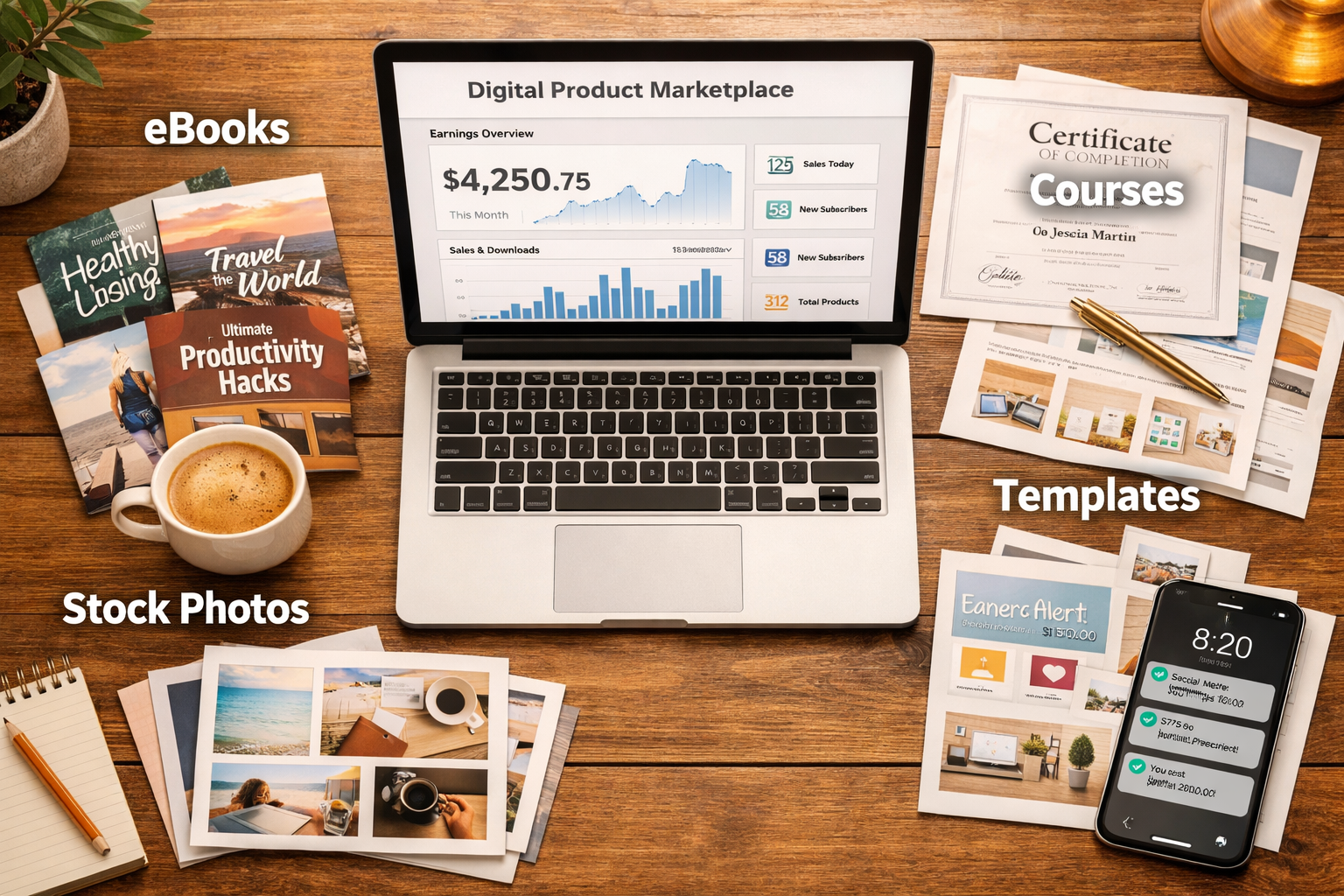
What Are Digital Products and Why Are They Ideal for Passive Income?
Digital products are files or content delivered electronically — no warehouse, no shipping label, no physical inventory. Once created, a single digital product can be sold thousands of times without additional production cost.
This makes them one of the most efficient income streams available. A freelancer can design a resume template once and sell it every day for years. A teacher can record a course once and enroll students indefinitely.
Why digital products work for passive income:
- Zero marginal cost: Selling one copy costs the same as selling 10,000.
- Automated delivery: Platforms send the file automatically after purchase.
- Global reach: Anyone with internet access can buy, regardless of time zone.
- Scalability: No cap on how many units can sell in a day.
Who this works best for: Beginners with a skill, knowledge, or creative ability they can package. It also works for people who want a side income without managing physical goods or clients.
Common mistake: Treating digital products as “set it and forget it” from day one. Most products need at least some marketing effort, especially in the first few months.
What Are the Best Digital Products to Sell Online for Passive Income?
The best digital products to sell online for passive income are the ones that match your existing skills, solve a clear problem, and have proven demand in a marketplace. Here are the top categories in 2026, ranked by beginner-friendliness.
1. eBooks and Guides
eBooks are one of the most accessible digital products to create. A 5,000–15,000 word guide on a specific topic — budgeting for beginners, meal planning, dog training — can sell for $7 to $29 and deliver real value.
Best platforms: Amazon Kindle Direct Publishing (KDP), Gumroad, Payhip
Realistic income: $100–$800/month for a well-positioned eBook in a niche market (estimate based on typical KDP author reports)
2. Online Courses
Online courses command higher prices ($47–$497) because they deliver structured learning. If you have expertise in graphic design, coding, cooking, or marketing, packaging that knowledge into video lessons is a strong income strategy.
Best platforms: Teachable, Thinkific, Kajabi, Udemy
Realistic income: $500–$5,000+/month for established courses with consistent traffic
3. Templates (Canva, Notion, Excel)
Templates save people time, and people will pay for that. Canva social media templates, Notion productivity dashboards, and Excel budget spreadsheets are consistently top sellers on Etsy and Gumroad.
Best platforms: Etsy, Gumroad, Creative Market
Realistic income: $200–$2,000/month with a strong template shop
4. Printables
Printables are downloadable PDFs — planners, habit trackers, wall art, kids’ activity sheets. They’re fast to create (often in Canva) and sell well on Etsy.
Best platforms: Etsy, Shopify, Payhip
Realistic income: $100–$1,500/month depending on volume and niche
5. Stock Photos, Videos, and Music
Photographers, videographers, and musicians can license their work repeatedly through stock platforms. Each upload becomes a potential income source.
Best platforms: Shutterstock, Adobe Stock, Pond5, AudioJungle
Realistic income: Highly variable; contributors with large portfolios report $200–$2,000+/month
6. Software, Plugins, and Apps
If you can code (or hire someone who can), software tools and plugins are among the highest-earning digital products. WordPress plugins and Chrome extensions with recurring subscription models are especially profitable.
Best platforms: Gumroad, your own website, WordPress plugin marketplace
Realistic income: Wide range; successful tools can generate $1,000–$10,000+/month
7. Digital Art and Design Assets
Fonts, icon sets, Procreate brushes, and Lightroom presets sell consistently to designers and content creators. These assets are created once and sold indefinitely.
Best platforms: Creative Market, Etsy, Gumroad
Realistic income: $150–$1,500/month for a well-stocked shop
| Digital Product | Skill Required | Startup Cost | Avg. Price Range | Best Platform |
|---|---|---|---|---|
| eBook | Writing | Low | $7–$29 | Amazon KDP, Gumroad |
| Online Course | Teaching/Expertise | Medium | $47–$497 | Teachable, Udemy |
| Templates | Design (Canva) | Low | $5–$35 | Etsy, Gumroad |
| Printables | Basic Design | Very Low | $3–$15 | Etsy |
| Stock Photos | Photography | Low-Medium | Per license | Shutterstock, Adobe |
| Software/Plugins | Coding | High | $9–$99/mo | Own site, Gumroad |
| Digital Art Assets | Design | Medium | $10–$50 | Creative Market |
How Do You Choose the Right Digital Product to Sell?
Choose based on three factors: your existing skills, market demand, and how quickly you can create something good enough to sell.
Decision framework:
- Choose eBooks or guides if you enjoy writing and have knowledge others want to learn.
- Choose templates or printables if you’re comfortable with Canva or basic design tools and want the fastest path to a first sale.
- Choose online courses if you have teachable expertise and are willing to invest 4–8 weeks in creation.
- Choose stock assets if you already create photos, music, or video as a hobby.
- Choose software only if you have coding skills or a budget to hire a developer.
Validate before creating: Search Etsy or Gumroad for your product idea. If similar products exist with reviews, that’s proof of demand. If nothing exists, that’s usually a warning sign, not an opportunity.
How Do You Create and Launch Your First Digital Product?
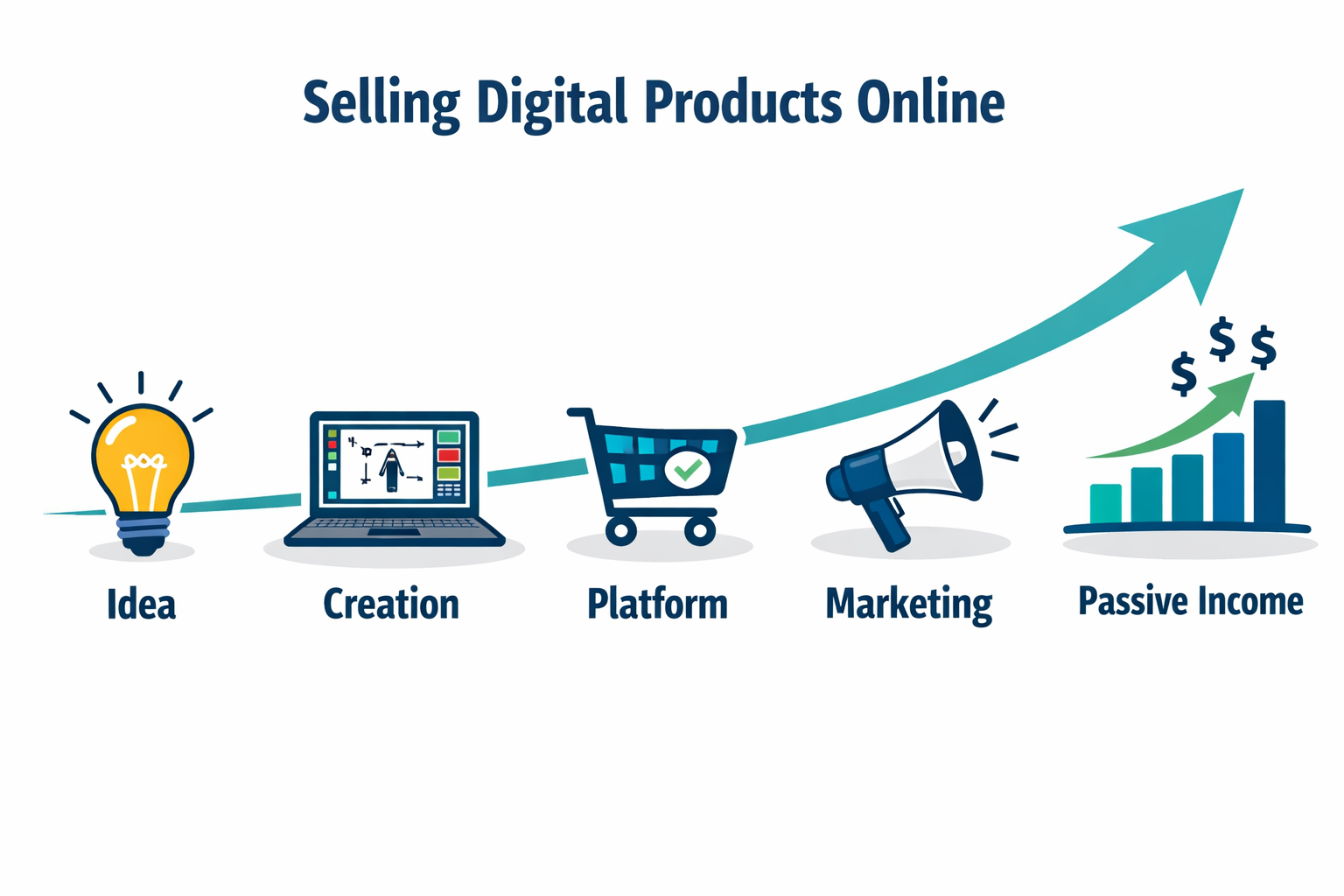
Creating and launching a digital product follows a repeatable process that most beginners can complete in 2–4 weeks for simpler products like templates or eBooks.
Step-by-step process:
- Pick a specific topic. “Meal planning for busy moms on a $200/week budget” outperforms “meal planning guide.”
- Research competitors. Look at top sellers on Etsy or Amazon. Note pricing, format, and reviews.
- Create the product. Use Canva for templates/printables, Google Docs or Scrivener for eBooks, Loom or Descript for course videos.
- Set up your storefront. Create a seller account on your chosen platform. Write a clear product title, description, and upload preview images.
- Price it strategically. Start at the mid-range for your category. Avoid pricing too low — it signals low quality.
- Launch with a small audience. Share in relevant Facebook groups, Reddit communities, or your social media. Ask for honest feedback.
- Collect reviews. Early social proof drives future sales more than almost anything else.
Common mistake: Spending weeks perfecting a product before anyone has seen it. Launch a “good enough” version, gather feedback, and improve from there.
What Platforms Are Best for Selling Digital Products?
The best platform depends on what you’re selling and how much control you want over your storefront and customer data.
- Gumroad: Best for beginners. Simple setup, handles payments and delivery, takes a small transaction fee. Works for eBooks, templates, courses, and more.
- Etsy: Best for printables and templates. Built-in audience of millions of buyers actively searching for digital downloads.
- Teachable / Thinkific: Best for online courses. Includes video hosting, student management, and payment processing.
- Amazon KDP: Best for eBooks. Massive built-in audience, but lower royalty rates and limited pricing control.
- Creative Market: Best for design assets, fonts, and templates targeting professional designers.
- Shopify: Best if you want full control over your brand and plan to scale. Requires more setup but offers the most flexibility.
Edge case: If you already have a social media following, selling directly through Gumroad or a simple Shopify store lets you keep more revenue and own your customer list — both of which are valuable long-term.
How Much Money Can You Realistically Make Selling Digital Products?
Income from digital products varies widely based on niche, quality, marketing, and consistency. Here are realistic benchmarks for beginners.
Beginner phase (months 1–3): $0–$300/month. Most of this time goes toward creating, listing, and learning what works.
Growth phase (months 4–9): $300–$1,500/month. Sales become more consistent as reviews accumulate and SEO kicks in on platforms like Etsy.
Established phase (month 10+): $1,500–$5,000+/month. At this point, multiple products, an email list, and repeat customers drive compounding growth.
What accelerates income:
- Building an email list from day one
- Creating multiple products in the same niche (buyers who trust you will buy again)
- Running occasional promotions or bundles
- Driving traffic from Pinterest, YouTube, or a blog — all of which have long content lifespans
Realistic expectation: Most beginners who stay consistent for 6 months and actively market their products can replace a part-time income. Replacing a full-time income typically takes 12–24 months of focused effort.
What Are the Most Common Mistakes Beginners Make?
Understanding where beginners go wrong saves months of wasted effort.
Mistake 1: Skipping validation. Creating a product nobody wants is the most common reason beginners give up. Always check for existing demand first.
Mistake 2: Pricing too low. A $1 eBook doesn’t signal value — it signals doubt. Price based on the transformation or time saved, not just the effort it took to make.
Mistake 3: Ignoring product presentation. A blurry cover image or a vague product description kills conversions. Spend time on mockups and clear descriptions.
Mistake 4: Listing once and waiting. Passive income doesn’t mean zero effort. Products need marketing, especially early on. Pinterest pins, YouTube videos, and email newsletters all drive consistent traffic.
Mistake 5: Spreading across too many platforms. Start with one platform, master it, then expand.
FAQ: Selling Digital Products for Passive Income
Q: Do I need a website to sell digital products?
No. Platforms like Gumroad, Etsy, and Teachable handle everything. A personal website helps long-term but isn’t required to start.
Q: How long does it take to make my first sale?
Most beginners make their first sale within 2–8 weeks if they actively promote their listing. Purely organic discovery on Etsy can take 4–12 weeks.
Q: What’s the easiest digital product to create for a complete beginner?
A Canva template or a simple printable PDF. Both can be created in a few hours using free tools and listed on Etsy the same day.
Q: Do I need to pay taxes on digital product income?
Yes. Digital product sales are taxable income in most countries. Track your earnings from the start and consult a local tax professional for specifics.
Q: Can I sell the same product on multiple platforms?
Yes, in most cases. Check each platform’s terms, but selling on Gumroad, Etsy, and your own site simultaneously is a common strategy.
Q: How do I protect my digital products from piracy?
Use PDF watermarking, license agreements, and platform-level protections. Some piracy is inevitable, but most buyers are honest. Don’t let fear of piracy stop you from launching.
Q: What’s the best niche for digital products in 2026?
Personal finance tools, productivity templates, AI prompt guides, and health/wellness planners are all strong performers in 2026 based on current marketplace trends.
Q: Do I need design skills to create templates?
Basic Canva skills are enough. Canva’s free plan includes hundreds of starting templates that can be customized and resold (check Canva’s licensing terms for commercial use).
Q: Is selling on Etsy competitive?
Yes, but niching down helps. “Printable weekly planner for ADHD adults” competes far less than “weekly planner printable.”
Q: How do I drive traffic to my digital product listings?
Pinterest, YouTube tutorials related to your product topic, a simple blog, and an email list are the most effective long-term traffic sources for digital product sellers.
Conclusion: Your Next Steps for Selling Digital Products Online
The best digital products to sell online for passive income are the ones you can create now, with the skills you already have. Waiting for the “perfect” idea or the “right” time is the only real obstacle.
Here’s what to do this week:
- Pick one product category that matches a skill you already have.
- Search Etsy or Gumroad to confirm people are buying similar products.
- Create a simple first version using Canva, Google Docs, or a tool you already know.
- Set up a free seller account on Gumroad or Etsy.
- Write a clear product description, create a clean cover image, and publish.
- Share the listing in at least three relevant online communities.
The income from digital products compounds over time. A template shop with 20 listings earns more than one with 3. An eBook with 50 reviews converts better than one with none. The only way to get there is to start.
“The creator who ships something imperfect today will always outperform the one who’s still perfecting tomorrow.”
Start small, stay consistent, and let the products work while you sleep.