
Last updated: March 20, 2026
Quick Answer
The best AI tools to make money online in 2026 include ChatGPT for content writing and freelancing, Canva AI for design services and template sales, Copy.ai and Jasper for professional copywriting gigs, Pictory for video content creation, and Notion AI for selling productivity templates. These tools require minimal technical skills and can generate income through freelancing platforms, digital product sales, or service-based side hustles within 30-60 days of consistent effort.
Use this tool to offer services, create content, or build your side hustle.
👉 Try it here →
💡 Beginner tip: Start with one tool and focus on getting your first paid client.
Key Takeaways
- AI tools have lowered the barrier to entry for online income, allowing complete beginners to start earning within weeks
- ChatGPT can generate $300-$1,500/month through content writing, social media management, and freelance services
- Canva AI enables template creation that sells passively on marketplaces like Etsy and Creative Market
- Video AI tools like Pictory automate YouTube content creation, reducing production time by 80%
- Realistic first-month earnings range from $100-$500 for beginners who commit 10-15 hours weekly
- The fastest path to income combines one AI tool with one established freelancing platform (Fiverr or Upwork)
- Avoid the mistake of learning too many tools at once—master one, earn money, then expand
- Success depends more on consistent client outreach than tool mastery
AI is changing how people make money online, and I’ve watched this transformation happen faster than anyone predicted. Just two years ago, you needed specialized skills to earn decent income online. Today, AI tools do the heavy lifting while you focus on finding clients and delivering results.
I’m going to show you exactly which AI tools beginners can use to start earning money in 2026, how to monetize each one, and realistic income expectations. This isn’t about get-rich-quick schemes. It’s about practical tools that solve real problems people pay for.
Why AI Tools Are the Fastest Way to Make Money in 2026
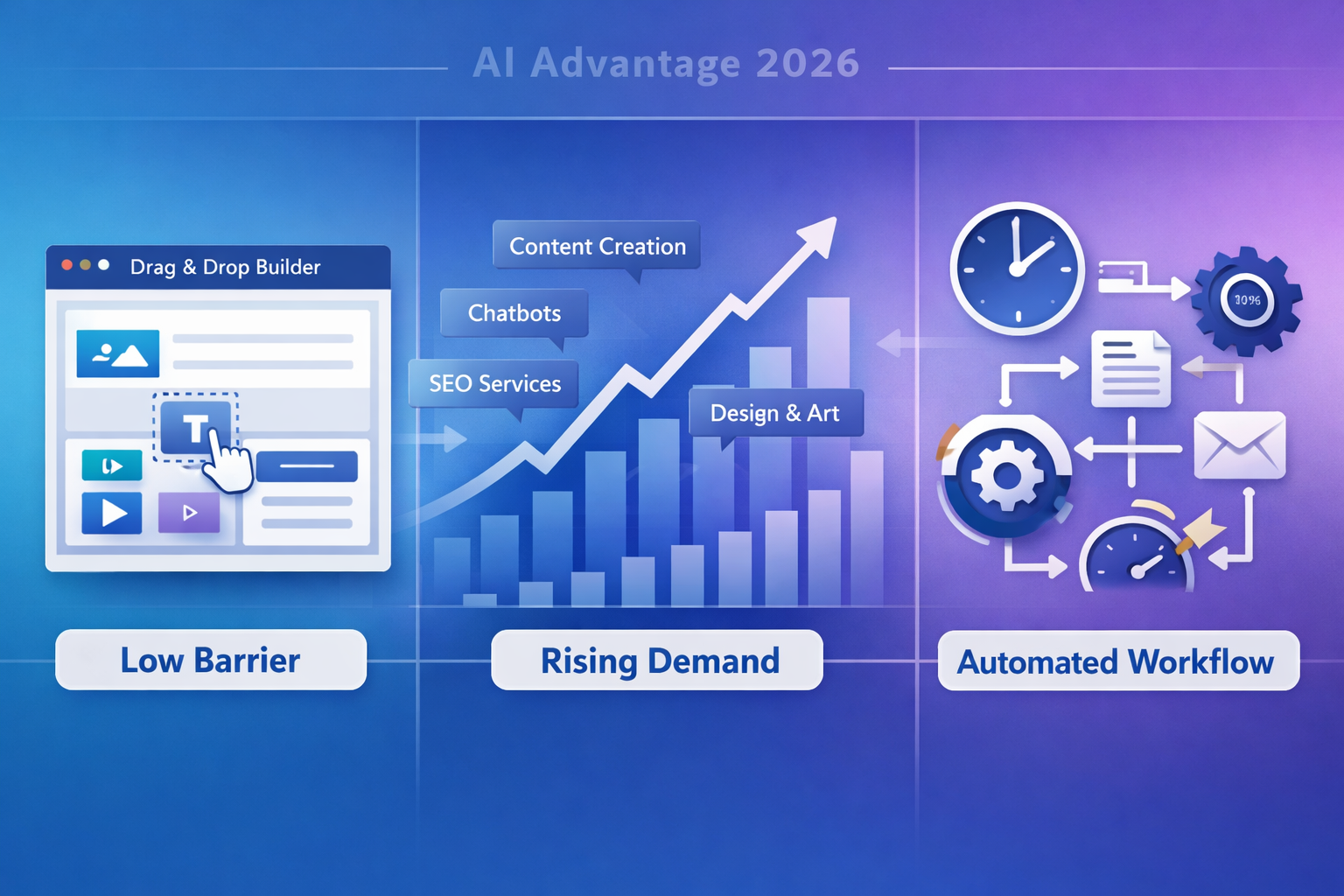
AI tools have eliminated the biggest obstacles that kept beginners from making money online: lack of technical skills, high startup costs, and time-intensive work processes.
The low skill barrier means you don’t need years of training. Most AI tools work through simple text prompts or drag-and-drop interfaces. A friend of mine started using ChatGPT for freelance writing with zero writing experience. Within three weeks, she landed her first $200 client. The AI handled grammar, structure, and research while she focused on understanding what clients wanted.
High demand for AI-assisted services is exploding. Businesses know AI exists but don’t have time to learn it themselves. They’re actively hiring people who can bridge that gap. On Upwork alone, job posts mentioning “AI tools” or “ChatGPT” increased by 340% between 2024 and 2026. Small business owners need social media content, blog posts, video editing, and graphic design—all services you can deliver faster and cheaper using AI.
The automation advantage multiplies your output. Traditional freelancers might write two blog posts per day. With AI assistance, you can deliver five to seven posts in the same timeframe while maintaining quality. This means you can either take on more clients or charge premium rates for faster turnaround times.
Here’s what makes 2026 different from previous years: AI tools are now reliable enough for professional work, affordable enough for beginners, and accepted enough by clients that using them isn’t seen as cheating—it’s seen as being efficient.
Best AI Tools to Make Money Online
These tools represent the most accessible entry points for beginners. Each one has proven monetization paths and active marketplaces where people are already earning.
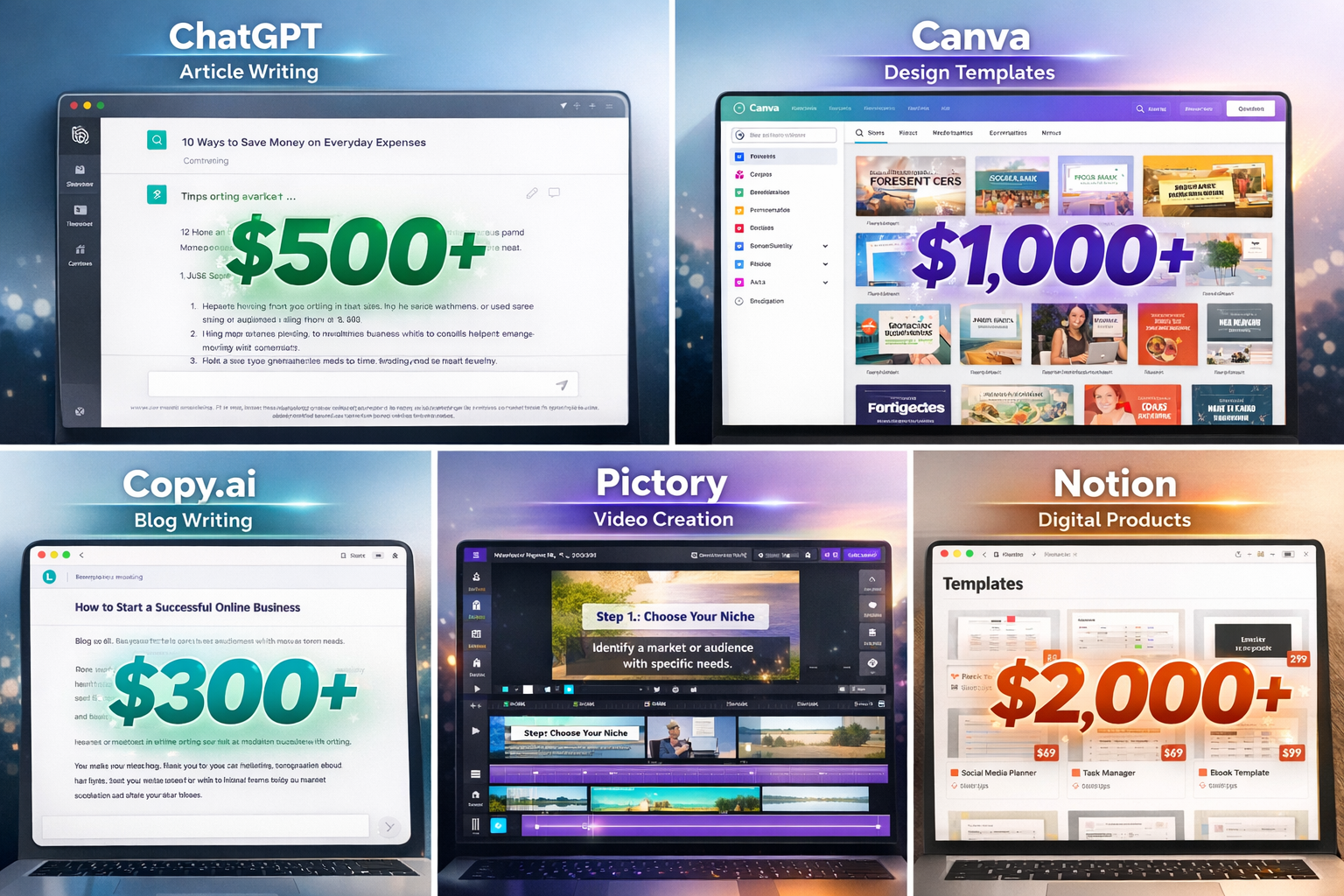
ChatGPT (Content + Freelancing)
ChatGPT is the most versatile AI tool for making money because it handles multiple income streams through one interface. You can earn money by offering content writing, email copywriting, social media management, blog post creation, product descriptions, and research services.
How to earn with ChatGPT:
Start by creating service packages on Fiverr or Upwork. Offer specific deliverables like “10 Instagram captions for $30” or “1,500-word blog post for $75.” Use ChatGPT to generate first drafts, then edit for accuracy and brand voice. The AI saves you 60-70% of the time compared to writing from scratch.
Example gigs that work:
- Social media content packages: Clients send you their business info, you use ChatGPT to create a week’s worth of posts. Charge $50-$100 per week per client. With five clients, that’s $250-$500 weekly.
- Blog writing services: Small businesses need SEO content. Use ChatGPT to research topics and create outlines, then refine the content. Charge $0.08-$0.15 per word. A 1,500-word post earns $120-$225.
- Email sequences: E-commerce stores need welcome emails and promotional campaigns. Create 5-email sequences for $150-$300 per project.
I tested this myself by offering “AI-assisted blog writing” on Fiverr. My first order came within four days. The client needed three 1,000-word articles about home renovation. I used ChatGPT for research and structure, spent about two hours editing, and earned $180. That’s $90/hour for work that would have taken me eight hours without AI.
Common mistake to avoid: Don’t copy-paste ChatGPT output directly. Clients can tell. Always add personal insights, verify facts, and adjust the tone to match the brand.
👉 Start using ChatGPT: Create a free account at OpenAI, practice writing in different styles, then list your first service on Fiverr this week.
Use this tool to offer services, create content, or build your side hustle.
👉 Try it here →
💡 Beginner tip: Start with one tool and focus on getting your first paid client.
Canva AI (Templates + Design)
Canva AI combines design automation with passive income potential. You don’t need design skills because Canva’s AI features handle layout, color matching, and element placement. The real money comes from creating templates that sell repeatedly.
Sell templates for passive income:
Create reusable templates for social media posts, presentations, resumes, wedding invitations, or business cards. Upload them to Etsy, Creative Market, or Canva’s own template marketplace. Each template sells for $5-$25, and once created, it generates income indefinitely.
One creator I follow makes $1,200-$1,800 monthly selling Instagram story templates on Etsy. She created 50 templates over two months, then let them sell on autopilot. Her best-selling pack (20 templates for $12) has sold over 400 times.
Active income options:
Offer custom design services for small businesses. Use Canva AI to create:
- Logo designs: $50-$150 per logo
- Social media graphics: $30-$50 for 10 posts
- Presentation decks: $100-$300 per deck
- Marketing materials: $75-$200 per project
How to get started:
Choose a niche (real estate agents, fitness coaches, wedding planners). Research what templates they need. Use Canva’s AI features to generate design variations quickly. Create a portfolio of 10-15 templates, then start selling.
👉 Try Canva Pro: The free version works, but Pro unlocks AI features like Magic Design and Background Remover that speed up your workflow. Start with the 30-day free trial.
Use this tool to offer services, create content, or build your side hustle.
👉 Try it here →
💡 Beginner tip: Start with one tool and focus on getting your first paid client.
Copy.ai / Jasper (Writing Gigs)
Copy.ai and Jasper specialize in marketing copy and long-form content. They’re more focused than ChatGPT for specific writing tasks, making them ideal for freelance copywriting services.
Freelance writing opportunities:
These tools excel at creating:
- Website copy: Homepage, about pages, service descriptions ($200-$500 per website)
- Ad copy: Facebook ads, Google ads ($50-$150 per campaign)
- Product descriptions: E-commerce stores need hundreds of these ($2-$5 per description)
- Sales emails: Promotional campaigns and newsletters ($100-$250 per sequence)
Blog content services:
Position yourself as a blog content specialist. Use Jasper’s SEO mode to create search-optimized articles. Charge $100-$200 per 1,500-word post. With consistent clients, you can build a $2,000-$4,000 monthly income stream.
Which tool to choose:
- Copy.ai: Better for short-form content, more affordable ($49/month), easier learning curve. Choose this if you’re starting with social media or ad copy.
- Jasper: Better for long-form content, includes SEO features ($49-$125/month depending on plan). Choose this if you want to focus on blog writing or content marketing.
Both tools offer templates for specific content types, which speeds up your workflow significantly. You can produce a complete blog post in 30-45 minutes instead of 3-4 hours.
Create blog posts, ads, and content for clients using AI tools like Jasper or Copy.ai.
👉 Try Jasper AI →
👉 Try Copy.ai →
💡 Start by offering simple writing gigs on Fiverr and scale to $500+/month.
Pictory / Video AI Tools
Video content dominates social media, but video editing intimidates most beginners. Pictory and similar AI video tools (like Descript or InVideo AI) automate the editing process, letting you offer video services without technical skills.
YouTube automation:
Create faceless YouTube channels in profitable niches (finance tips, productivity hacks, motivational content). Use Pictory to:
- Convert blog posts or scripts into videos
- Add stock footage automatically
- Generate captions and transitions
- Export ready-to-upload content
Channels using this method can reach monetization thresholds (1,000 subscribers, 4,000 watch hours) in 6-12 months. Once monetized, channels earn $200-$2,000 monthly depending on niche and views.
Reels and short-form content:
Businesses need constant short video content for Instagram Reels, TikTok, and YouTube Shorts. Offer packages like “12 Reels per month for $300.” Use AI to batch-create videos in 2-3 hours, giving you a healthy profit margin.
Client service model:
Offer video editing services on Fiverr:
- Podcast video editing: $50-$150 per episode
- Social media video packages: $200-$400 for 10 videos
- YouTube video editing: $75-$200 per video
Realistic timeline: Video services take longer to build than writing services because you need a portfolio. Spend your first two weeks creating sample videos, then start pitching clients.
Use AI video tools to create YouTube videos, reels, and client content without editing skills.
👉 Start with Pictory →
💡 Offer video packages on Fiverr and charge $100–$400 per project.
Notion AI (Templates + Productivity)
Notion AI helps you create productivity templates that sell to remote workers, students, and small business owners. The Notion template marketplace is less saturated than design marketplaces, creating opportunities for new sellers.
Sell Notion templates:
Popular template categories include:
- Project management dashboards: $10-$30
- Content calendars: $8-$20
- Budget trackers: $5-$15
- Goal-setting systems: $12-$25
- Business operating systems: $30-$100
Create templates once, sell them repeatedly on Gumroad, Notion’s template gallery, or your own website. Successful template creators earn $500-$3,000 monthly with a catalog of 15-30 templates.
Service-based income:
Offer Notion setup services for businesses transitioning to remote work. Charge $300-$800 to build custom workspace systems. Use Notion AI to generate formulas, automate databases, and create documentation.
One template creator started by giving away three free templates to build an email list, then launched a paid bundle of 10 templates for $45. She made $2,700 in the first month from 60 sales, mostly from organic search traffic and Reddit recommendations.
Create productivity templates and sell them for passive income on Gumroad or Etsy.
👉 Start using Notion AI →
💡 One good template can generate income for months.
Step-by-Step: How to Start Making Money with AI
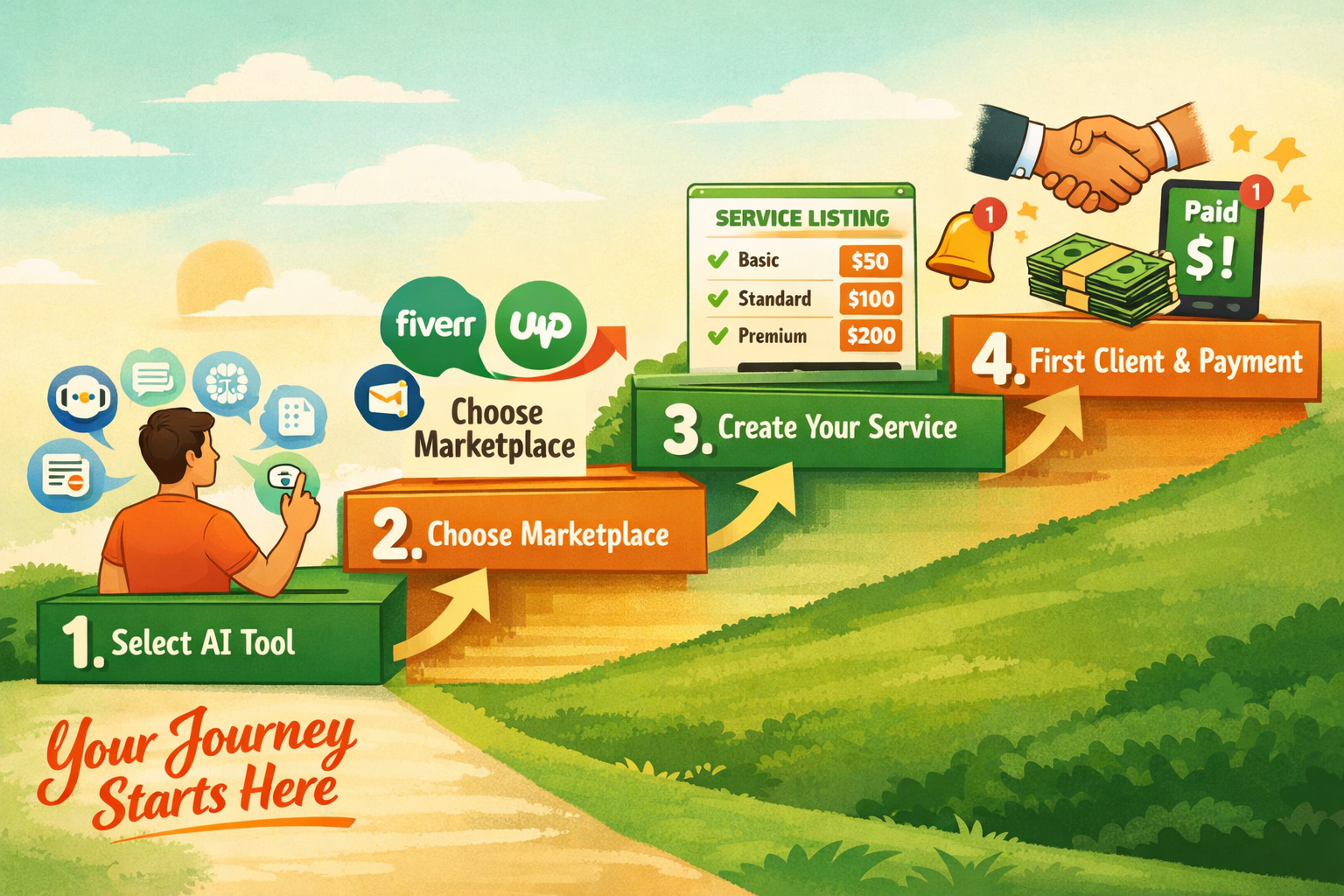
This process works regardless of which tool you choose. Follow these steps in order, and you’ll have your first paying client within 30 days.
Step 1: Pick one tool and learn it deeply
Don’t try to master everything at once. Choose the tool that matches your natural interests:
- Like writing? Start with ChatGPT or Copy.ai
- Enjoy visual work? Choose Canva AI
- Interested in video? Pick Pictory
- Organized and systematic? Try Notion AI
Spend one week learning your chosen tool. Watch YouTube tutorials, complete practice projects, and understand its limitations. Create 5-10 sample pieces for your portfolio.
Step 2: Choose your platform
You need a marketplace where clients already look for services. The three best options for beginners:
- Fiverr: Best for productized services (fixed packages). Create 3-5 gig listings with clear deliverables. Expect your first order in 1-3 weeks.
- Upwork: Best for ongoing client relationships. Create a detailed profile, take skill tests, and submit 5-10 proposals daily. First client typically comes in 2-4 weeks.
- Direct outreach: Contact businesses directly via email or LinkedIn. Slower to start but higher rates. Best after you have 2-3 portfolio pieces.
Step 3: Create your service offering
Package your AI skills into specific, easy-to-buy services. Use this formula:
[Deliverable] + [Quantity] + [Timeframe] = [Price]
Examples:
- “5 blog posts (1,500 words each) delivered in 7 days for $500”
- “30 social media graphics delivered in 3 days for $150”
- “1 YouTube video edited and delivered in 48 hours for $100”
Price competitively at first. Your goal is getting reviews and testimonials, not maximizing profit. After 10-15 completed orders, raise your rates by 20-30%.
Step 4: Get your first client
On Fiverr: Optimize your gig titles with keywords clients search for. Offer a limited-time discount (20% off) to your first five clients. Respond to messages within one hour.
On Upwork: Write personalized proposals. Reference specific details from the job posting. Explain how you’ll solve their problem, not just what tools you use. Apply to 10-15 jobs daily.
For direct outreach: Find 20 businesses in your target niche. Send personalized emails offering a free sample or discounted first project. Follow up once after three days.
Timeline expectations:
- Week 1: Learn tool, create portfolio samples
- Week 2: Set up marketplace profile, create service listings
- Week 3-4: Apply to jobs or wait for first order
- Week 4-6: Complete first 3-5 projects, get reviews
- Week 6-8: Raise rates, expand services
Realistic Earnings: What to Expect in 2026
Let me be honest about income expectations because most articles overpromise and underdeliver.
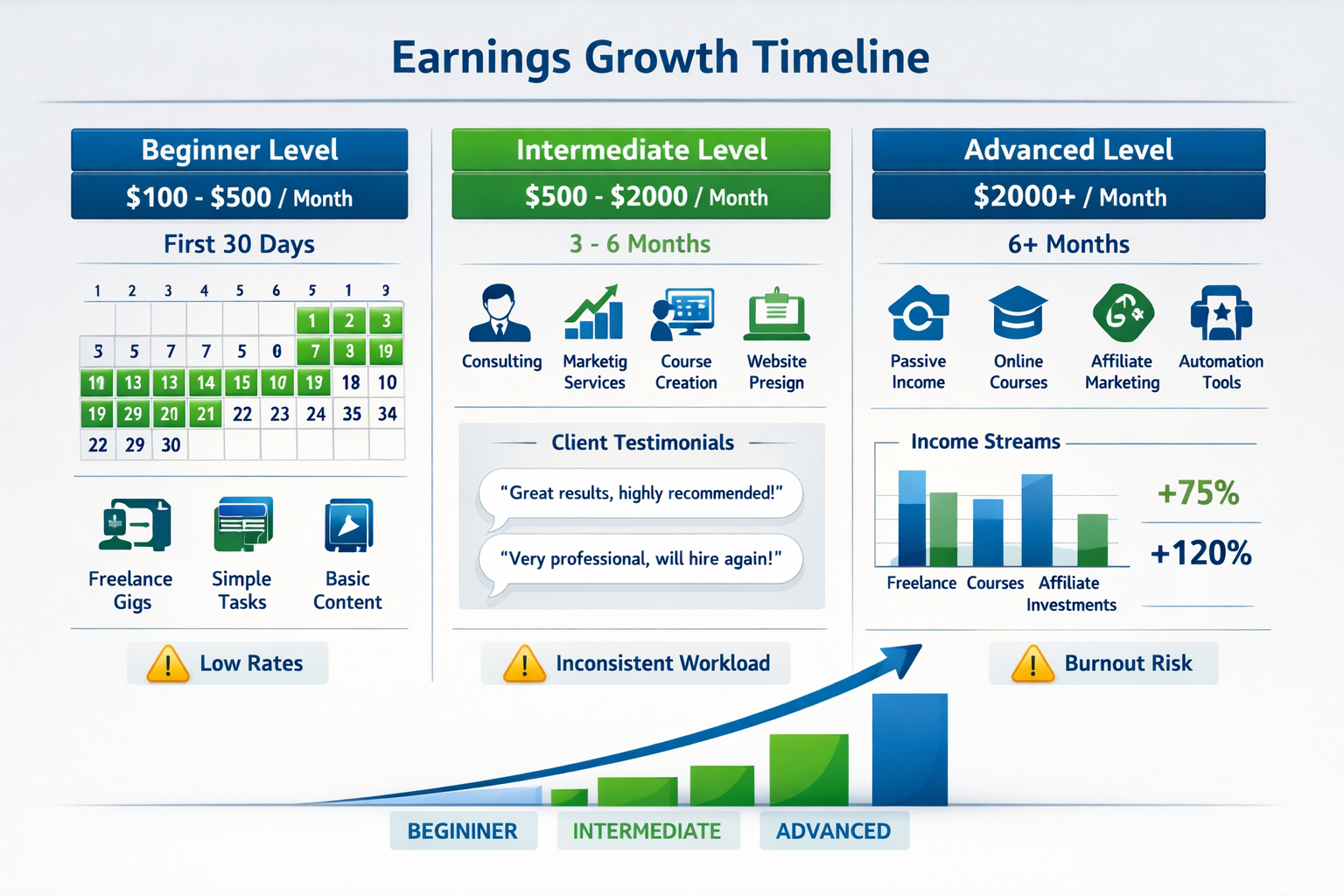
Month 1: $100-$500
Your first month focuses on learning and landing initial clients. Most beginners earn $100-$300 in their first 30 days. You’ll charge lower rates to build reviews and experience. If you land two clients at $150 each, you’ve hit $300—that’s a realistic and achievable goal.
Months 2-3: $500-$1,500
By month two, you have reviews and know your workflow. You can raise rates by 20-30% and take on more clients simultaneously. At this stage, you might have 3-5 active clients paying $200-$400 each monthly for ongoing services.
Months 4-6: $1,500-$3,000
You’ve established a reputation and refined your services. You’re charging market rates and possibly working with retainer clients. Some beginners reach $2,000-$2,500 monthly by month six if they’re consistent with client outreach.
Beyond 6 months: $3,000+
Income varies widely based on your niche, rates, and client base. Some freelancers plateau at $2,000-$3,000 monthly working part-time. Others scale to $5,000-$8,000 by specializing in high-value services or building passive income streams through template sales.
Factors that increase earnings:
- Specialization: Focusing on one niche (real estate, fitness, SaaS) lets you charge 30-50% more than generalists
- Retainer clients: Monthly recurring clients provide stable income and reduce time spent finding new work
- Passive products: Templates and digital products add income without trading time for money
- Premium positioning: Positioning yourself as an expert rather than a beginner justifies higher rates
What slows down earnings:
- Inconsistent work schedule (sporadic effort produces sporadic income)
- Underpricing services (charging too little attracts problem clients and devalues your work)
- Poor communication (slow responses lose clients to faster competitors)
- No marketing (waiting for clients to find you instead of actively promoting services)
Reality check: Most people who try making money with AI tools quit within the first month because they expect faster results. The ones who succeed treat it like a real business: they show up consistently, improve their skills, and persistently market their services.
Common Mistakes to Avoid
I’ve made most of these mistakes myself, and I’ve watched dozens of beginners make them too. Avoid these pitfalls and you’ll progress faster.
Mistake 1: Learning too many tools at once
Beginners often try to master ChatGPT, Canva, video editing, and Notion simultaneously. This spreads your attention too thin. You end up mediocre at everything instead of excellent at one thing. Pick one tool, get profitable with it, then expand.
Mistake 2: Copying AI output without editing
AI-generated content needs human refinement. Clients can spot unedited AI writing—it sounds generic and sometimes includes factual errors. Always spend time editing, fact-checking, and adding personality. Your value isn’t just using AI; it’s combining AI efficiency with human judgment.
Mistake 3: Underpricing to compete
New freelancers often charge $5-$10 for services that should cost $50-$100. This attracts difficult clients who don’t value your work and makes it impossible to earn decent income. Price fairly from the start. If you’re 20% below market rate, you’ll still get clients while earning reasonable money.
Mistake 4: No portfolio or samples
You can’t expect clients to hire you without seeing examples of your work. Create 3-5 sample projects before you start looking for clients. These don’t need to be paid projects—create them for fictional businesses or offer free work to one local business in exchange for a testimonial.
Mistake 5: Waiting for perfect conditions
Beginners wait until they’ve watched every tutorial, read every guide, and feel completely confident. That day never comes. Start before you feel ready. Your first projects won’t be perfect, and that’s fine. You learn more from doing one real project than from watching ten tutorials.
Mistake 6: Ignoring client communication
Fast, clear communication matters more than you think. Respond to messages within a few hours. Set clear expectations about deliverables and timelines. Update clients on progress. Good communication leads to repeat business and referrals—your most valuable income sources.
Mistake 7: Giving up too early
Most people quit after two weeks of no results. The reality is that building any income stream takes 4-8 weeks of consistent effort. Your first month is about learning and positioning. Your second month is when income starts flowing. Give yourself at least 60 days before evaluating whether this works.
Final Thoughts: Your Next Steps
The best AI tools to make money online in 2026 are already available and proven. Thousands of beginners are earning their first $500, $1,000, or $5,000 monthly using the exact tools and methods I’ve outlined.
The difference between people who succeed and people who don’t isn’t talent or luck—it’s taking action. You now know which tools to use, how to monetize them, and what realistic earnings look like. The only question left is: will you start?
Here’s what to do this week:
- Choose one AI tool from this list based on your interests
- Create three portfolio samples to show potential clients
- Set up a profile on Fiverr or Upwork
- List your first service with clear deliverables and pricing
- Apply to five jobs or promote your service to your network
Don’t wait for perfect timing or perfect skills. Start messy, learn as you go, and adjust based on what works.
👉 Take action now: Pick your tool, create your first service listing, and commit to 30 days of consistent effort. Your first client is waiting—you just need to show up and make yourself available.
The AI revolution isn’t coming. It’s already here. The people making money are the ones who stopped researching and started doing. Join them today.
🚀 Ready to Start Making Money Online?
You don’t need perfect skills — you just need to start.
Pick one AI tool from this list and take action today.
👉 Start with ChatGPT or Canva — both are beginner-friendly.
Start Now →Frequently Asked Questions
Do I need technical skills to make money with AI tools?
No, you don’t need technical skills. Modern AI tools use simple text prompts or drag-and-drop interfaces designed for beginners. If you can type a sentence or click a mouse, you can use these tools. The learning curve for basic proficiency is typically 3-7 days.
How much money can beginners realistically make in the first month?
Most beginners earn $100-$500 in their first month. This assumes you spend 10-15 hours weekly learning the tool, creating portfolio samples, and actively seeking clients. Some earn nothing in month one if they only focus on learning without marketing their services.
Which AI tool is easiest for complete beginners?
ChatGPT and Canva AI are the easiest starting points. ChatGPT requires no design skills—just typing questions and prompts. Canva AI has a visual interface with templates that guide you. Both have free versions you can use to start earning before paying for premium features.
Do I need to disclose that I use AI tools to clients?
This depends on the client and platform. Many clients expect and appreciate AI-assisted work because it means faster delivery. Be transparent if asked directly, but focus on the results you deliver rather than the tools you use. Your value is in understanding client needs and delivering quality work, not in manual labor.
Can I really make passive income with AI-generated templates?
Yes, but “passive” is misleading. You’ll spend 20-40 hours creating a catalog of 15-30 templates initially. After that, templates can sell for months or years with minimal maintenance. Successful template sellers earn $300-$2,000 monthly, but it takes 2-4 months to build a profitable catalog.
What if AI tools make mistakes or generate incorrect information?
AI tools do make mistakes, especially with facts, numbers, and current events. This is why you must review and edit all AI output before delivering it to clients. Your job is quality control—use AI for speed and efficiency, but apply human judgment to ensure accuracy and appropriateness.
How long until I get my first paying client?
On Fiverr, your first order typically comes within 1-3 weeks after listing your services. On Upwork, expect 2-4 weeks of consistent proposals before landing your first client. Direct outreach can be faster (1-2 weeks) if you target the right businesses, but requires more proactive effort.
Should I use free or paid versions of AI tools?
Start with free versions to validate your business model. Once you’re earning $300-$500 monthly, upgrade to paid versions. Paid plans offer faster processing, more features, and higher output limits that become necessary as you scale. The investment pays for itself quickly when you’re actively earning.
What’s the best niche for AI-powered services?
The best niche is one you understand or find interesting. Popular profitable niches include real estate (property descriptions, social media), fitness (workout content, meal plans), e-commerce (product descriptions, ad copy), and coaching/consulting (lead magnets, email sequences). Choose based on your background or interests.
Can I do this while working a full-time job?
Yes, most beginners start part-time while employed. Dedicate 10-15 hours weekly (evenings and weekends) to building your AI side hustle. This schedule allows you to reach $500-$1,500 monthly within 2-3 months without quitting your job. Scale up once your side income approaches your full-time salary.
What equipment or software do I need to start?
You need a computer or laptop with internet access. Most AI tools are web-based and work on any modern computer. Total startup costs range from $0-$50 monthly if you start with free tool versions and free freelancing platforms. Upgrade to paid tools ($50-$150/month) once you’re earning consistently.
How do I handle competition from other AI users?
Competition exists, but the market is growing faster than the number of service providers. Differentiate yourself through specialization (focus on one niche), excellent communication (respond faster than competitors), and quality work (edit AI output thoroughly). Most clients value reliability and results over price.